

Vector RAG vs. Structured Knowledge: Choosing the Right Retrieval for the Right Data
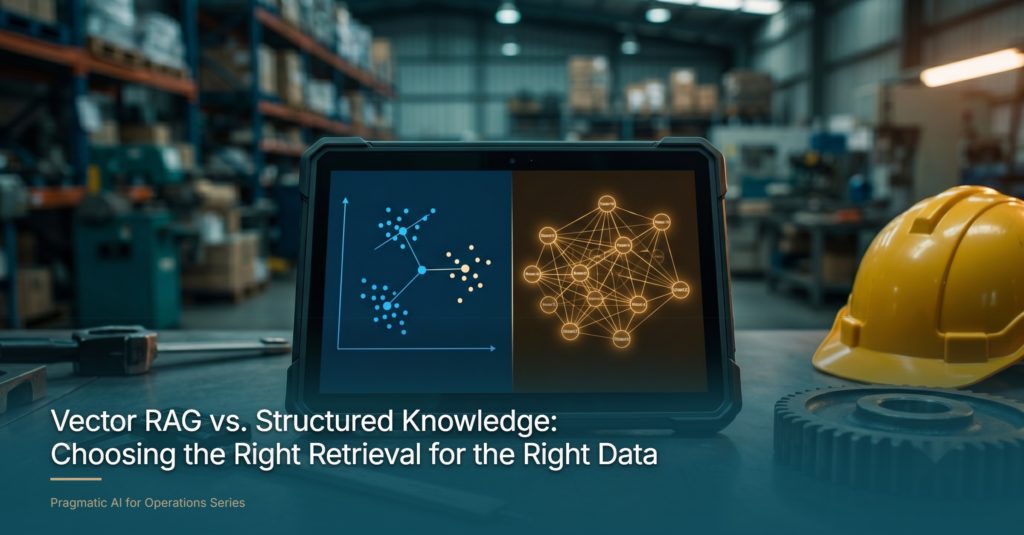
Let’s simulate that your AI agent recommended ordering a replacement valve based on a semantic search of a maintenance manual. It missed the fact that the valve is part of a retired line. A €15,000 inventory mistake.
AI hallucinations in real world environments can cost a lot.
This is the fourth episode of Pragmatic AI for Operations, a series designed to bring architectural discipline to generative AI projects on the factory floor.
The Hallucination Factory
Accuracy is the first casualty when generative AI hits operations. If the AI suggests a part that has been deprecated, or assumes a customer order is active when it has been cancelled, it breaks the physical flow.
To solve this, most teams nowadays build a Vector RAG (Retrieval-Augmented Generation) system.
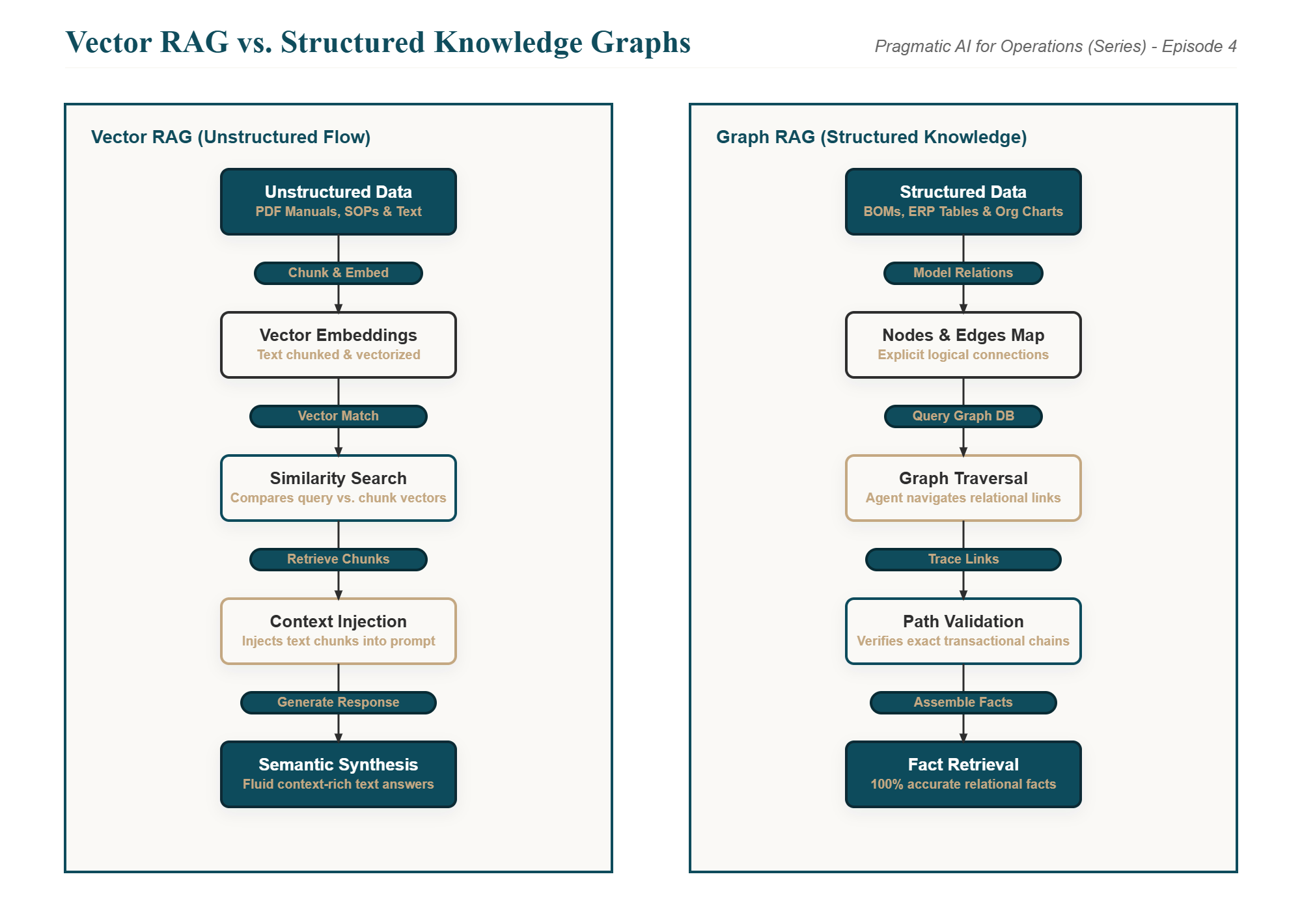
They convert their unstructured manuals, SOPs, and emails into mathematical representations called vectors. When a user asks a question, the system searches the database for passages with similar meanings, injects them into the model’s context window, and generates an answer.
For unstructured text, where you need to match the conceptual meaning of a query rather than exact keywords, this approach gives the best result.
But when it comes to structured enterprise data, vector similarity becomes a liability. A vector database is blind to structure, hierarchy, and explicit relationships.
It searches for similarity, not exact relational truth.
Why Semantic Similarity Fails: The BOM Test
To understand where this logic breaks down, lets take a look at a standard operational challenge on the assembly line.
A technician needs to find out if Part A can replace Part B on Machine X.
They ask the AI agent. If the system relies on Vector RAG, the model searches the indexed engineering manual. The manual states: Part A and Part B are both high-pressure hydraulic fittings used in machinery.
Because the text descriptions are similar, the system calculates a 95% semantic match. The agent responds: Yes, Part A is a suitable replacement for Part B.
But the database hierarchy of the ERP tells a different story.
The Bill of Materials (BOM) shows that Part A has a different thread size, and is only compatible with Machine Y, not Machine X. The relationship is explicit, rigid, and mathematical. It cannot be resolved by comparing the similarity of text descriptions.
Vector search was built for fluid, unstructured meaning. Hierarchical data demands precision it cannot deliver.
It cannot navigate a tree of dependencies. It treats a structured relational table like an unstructured essay.
Structured Knowledge: The Graph Solution
To prevent these errors, we must map explicit business relationships using Knowledge Graphs.
A Knowledge Graph is a structured database where data is represented as nodes (entities) and edges (defined relationships). For example: [Part A] – (compatible_with) -> [Machine Y] or [Order 102] – (contains) -> [Item 5] – (stored_in) -> [Bin 12].
This maps the exact structure of your ERP and WMS. There is zero ambiguity.
When we combine this with generative AI, we use a technique called Graph RAG.
Instead of searching by similarity, the AI agent is forced to navigate the logical paths of the Knowledge Graph. It follows the links between nodes to retrieve facts.
If the agent needs to trace a Sales Process from a Lead to a Quote, to an Order, and finally to an Invoice, Graph RAG follows the explicit transactional chain in the database.
The agent follows the explicit links between nodes, tracing the real logical path through the data.
This eliminates the risk of the model hallucinating a connection that doesn’t exist.
Choosing the Right Tool for the Right Data
Implementing a reliable retrieval layer requires matching the data type to the search mechanism.
We can divide enterprise data into two categories:
Unstructured text (Vector RAG)
PDF maintenance manuals, safety logs, customer feedback threads, historical email chains. Documents where meaning is fluid and scale is large. Vector RAG excels here because the user rarely searches with the exact words that appear in the files.
Relational and hierarchical structures (Graph RAG)
Bills of Materials, organization charts, process sequences from Quote to Order, product compatibility tables. Structure is rigid. A wrong link means a wrong part on the assembly line. Graph RAG ensures the agent respects the exact dependencies defined in your systems.
The Hybrid Architecture
The most effective operational blueprint combines both retrieval methods in a hybrid system.
A maintenance agent is assisting a technician on the production line.
First, the agent uses Graph RAG to query the Knowledge Graph, identifying the exact part numbers compatible with the machine. This establishes the structural truth.
Second, the agent uses Vector RAG to query the vector database, pulling the installation instructions for those specific part numbers from the PDF manual.
The graph defines what is correct. The vector database explains how to execute it.
By separating the structural validation from the text search, you get the best of both worlds: the safety of a relational database and the flexibility of a natural language interface. The technician gets a verified answer in seconds, instead of flipping through a 300-page manual while the line waits.
Decoupling the Retrieval Layer
In alignment with our core series design, these retrieval databases must live at the edge.
The Knowledge Graph and the vector database are deployed as synchronized read-only replicas. They index the data without placing a query burden on your transactional system. A scheduled sync pushes updates from the core ERP to the edge replicas, keeping the retrieval layer current without exposing the transactional engine to direct agent queries.
The core database stays clean and standard.
The AI agent retrieves information from these edge databases, structures the recommendation, and prepares the action. But it never writes to the core without human approval.
By matching the retrieval method to the data structure, you build an AI system that planners and technicians can trust. You move from the hype of chat interfaces and build a reliable operational tool.
In our next episode, we will focus on data security: Keeping Your Data Behind the Firewall with local open-weight models and private read replicas.
Written by Andrea Guaccio
July 16, 2026