

AI vs. GenAI vs. Agentic AI: Decoding the Infor Landscape
(Part 1 of the series: The ERP Intelligence Evolution: From Data to Agents)
In the boardroom, “AI” is a buzzword thrown around to solve every problem. On the shop floor, it’s a source of confusion. “Is this ChatGPT for my warehouse?” “Will it predict stockouts or write emails?” “Is it safe?”
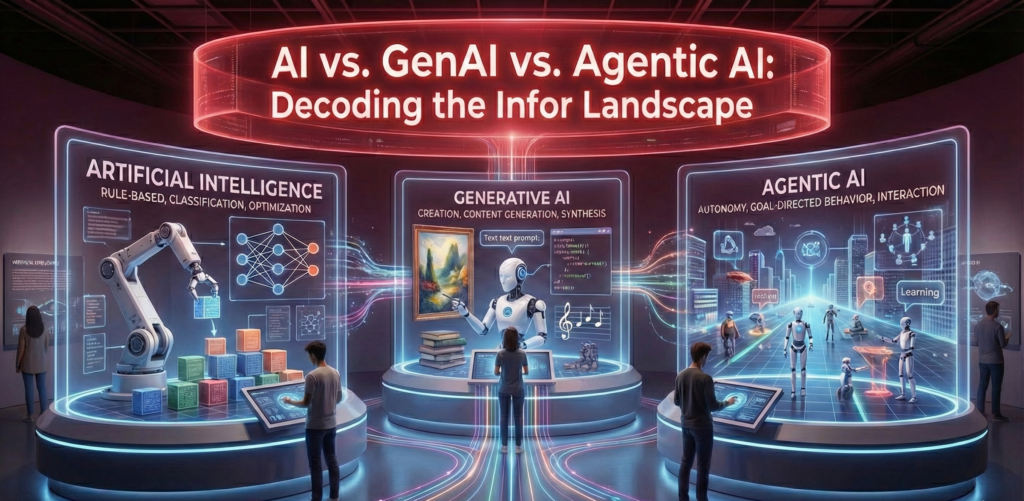
To build a realistic roadmap for Infor LN, generic definitions are dangerous. We must look at the official architecture. Based on Infor’s technical strategy, we are not dealing with a single monolithic technology, but a specific trinity: Infor AI, GenAI, and Agentic AI.
Understanding the difference it will help you to understand what business problems you can actually solve.

Infor AI: The Predictive Analyst
Inside official documentation, Infor AI (formerly known as the Coleman AI Platform) refers specifically to the Predictive and Prescriptive engine.
Think of Infor AI as your Best Data Scientist.
It loves numbers, patterns, and history.
It does not create new content (it won’t write a poem).
Instead, it consumes massive amounts of structured historical data to find hidden patterns.
Under the Hood:
- Machine Learning (ML): It uses algorithms (like regression or classification) to train models.
- Quests: In Infor’s terminology, you build “Quests”, specific ML workflows that handle data preparation, feature engineering (detecting outliers), and training.
- Structured Data: It thrives on clean rows and columns (Sales History, IoT Sensor readings).
The Infor LN Use Case: Demand Forecasting
You don’t ask Infor AI “How are sales going?”. You feed it 5 years of sales history, seasonality indices, and economic factors. It runs a Quest and outputs:
“You will sell 452 units of Item X in November with 92% confidence.”
GenAI: The Contextual Engine
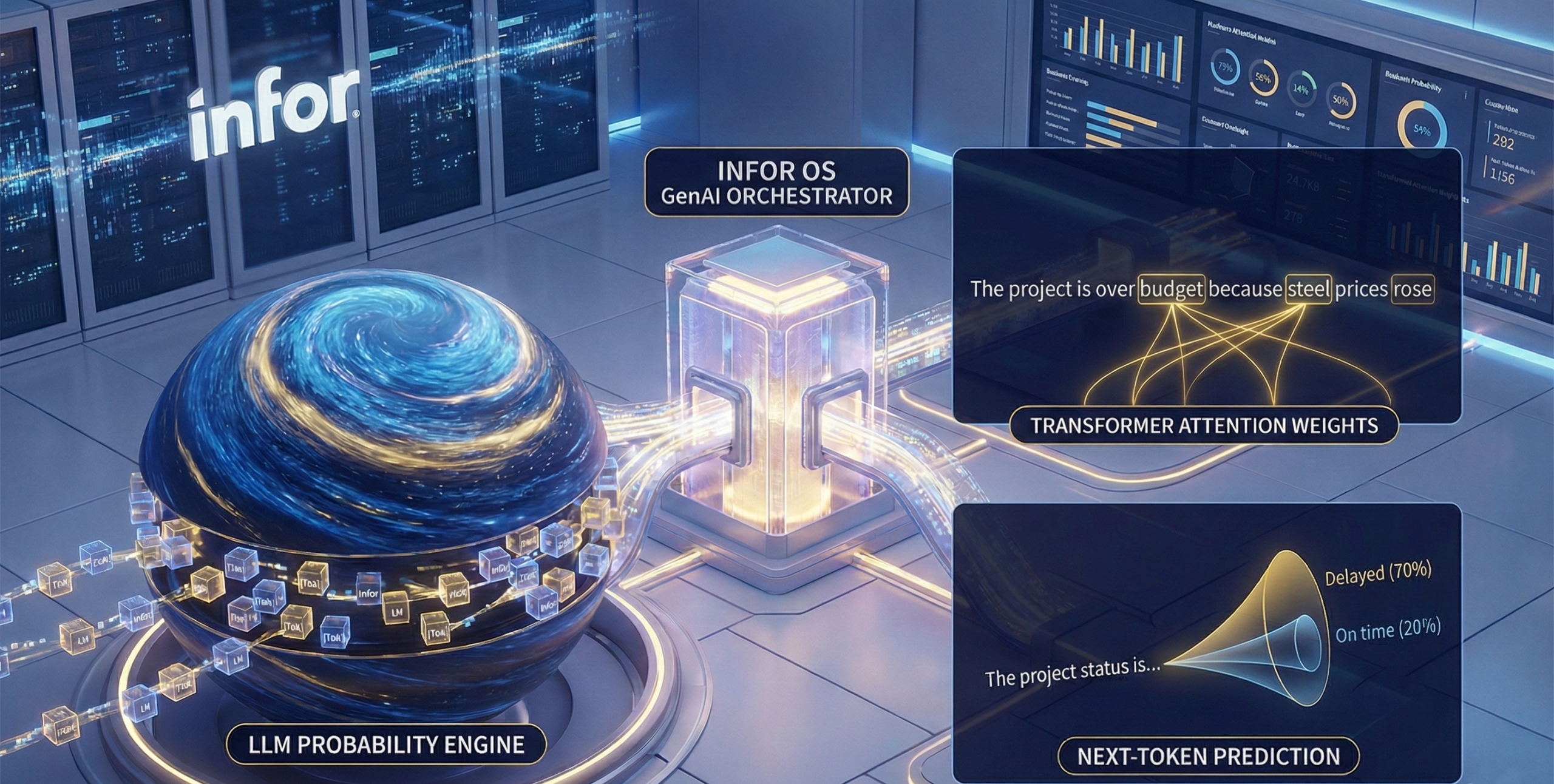
The Official Definition: GenAI is the capability powered by Large Language Models (LLMs) integrated into Infor OS via the GenAI Orchestrator.
This is where the “hype” usually focuses, but Infor’s approach is strictly business-oriented.
Under the Hood: How GenAI Actually “Thinks”
To understand why GenAI is different from traditional software, we need to break down three core concepts: LLMs, Tokens, and Transformers.
- The LLM (Large Language Model)
An LLM is not a “knowledge base” like a library; it is a probabilistic engine. It has been trained on vast amounts of text to learn the statistical relationship between words. It doesn’t “know” the answer; it predicts the most likely response based on patterns. - The Token: The Currency of AI
GenAI doesn’t read words like we do. It breaks text down into Tokens (roughly 4 characters or 0.75 words).
- Input: “Infor LN”
- AI View: [Infor] [ LN] (2 tokens) When you pay for GenAI services (via AWS Bedrock or Infor tokens), you are paying for the processing of these chunks.
- The Transformer
This is the breakthrough technology (the “T” in GPT).
Unlike older models that read text left-to-right, a Transformer reads the entire sentence at once and assigns “Attention Weights” to different tokens.
- Sentence: “The project is over budget because steel prices rose.”
- Mechanism: The Transformer understands that the word “budget” is mathematically linked to “steel”. It understands context, not just keywords.
- Next-Token Prediction When GenAI writes a summary, it is literally playing a game of “Guess the Next Word”.
- It reads your prompt: “The project status is…”
- It calculates probabilities: “Delayed” (70%), “On time” (20%), “Unknown” (10%).
- It picks “Delayed” and repeats the process.
Recommended Watch: For a visual explanation of these concepts, check out Google Cloud’s Introduction to Generative AI:
The Infor LN Use Case: Project 360 Widget In sessions like Project 360 (tppdm6500m100), Infor applies this technology specifically:
- The Input: the system feeds the LLM structured data (budget rows, open issues, milestones) converted into tokens.
- The Prompt: you click a pre-engineered prompt like “Project Executive Summary”.
- The Output: the Transformer analyzes the tokens and generates a cohesive narrative:
“The project is delayed by 3 weeks due to resource shortages in Phase 2. Material costs are 10% above estimate.”
Agentic AI: The Autonomous Future
The Official Definition: this is the new frontier described in the roadmap.
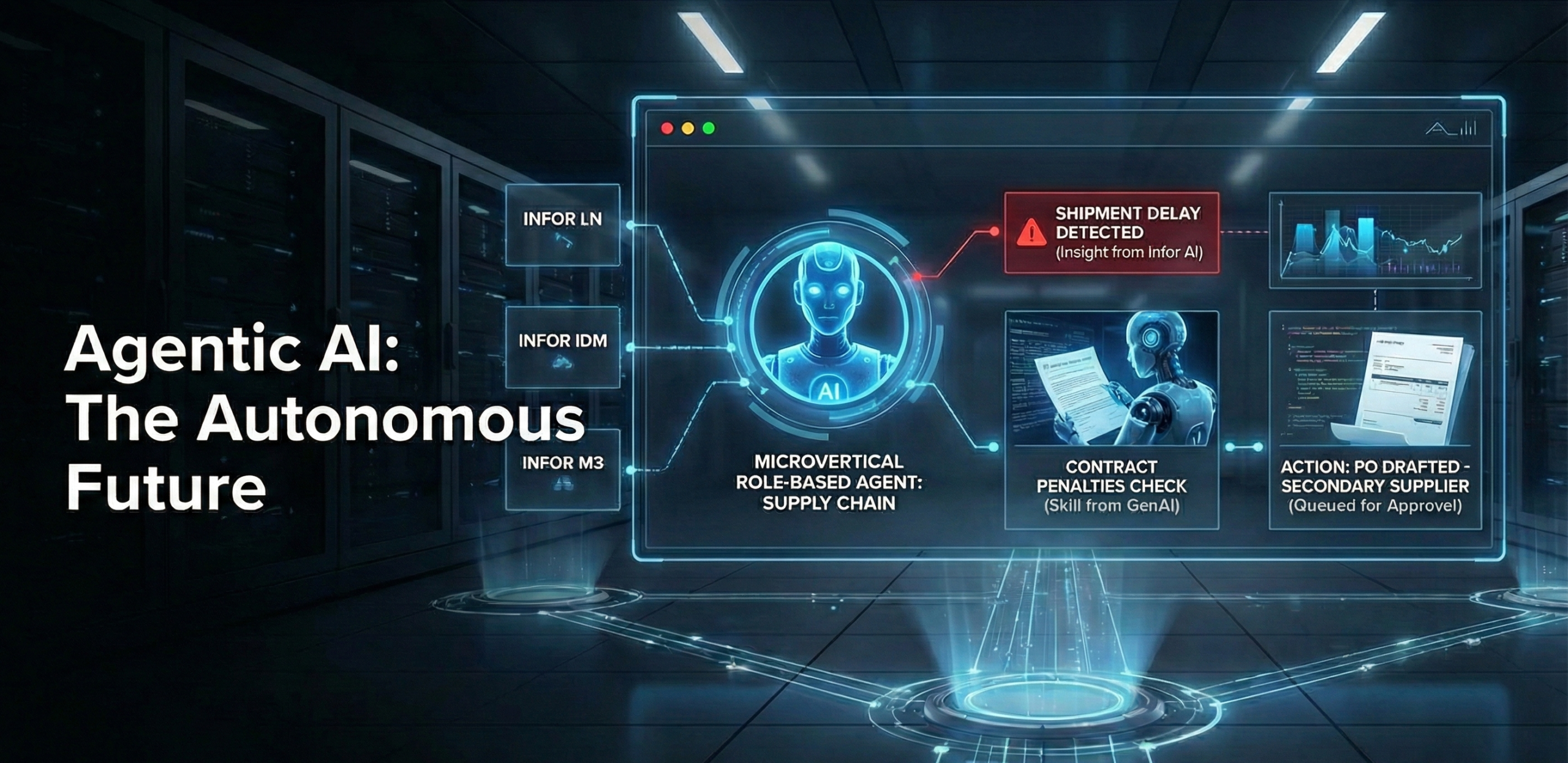
Agentic AI refers to “Microvertical Role-Based Agents”.
The Logic: while GenAI assists (you have to click “Summarize”), Agentic AI acts. It is Outcome-Driven, not Task-Driven.
Under the Hood: Agents are designed with “Orchestrated Control”.
They have the security clearance and the logic to execute processes across the Infor suite (LN, IDM, M3) autonomously, usually waiting only for a final “human nod”.
Imagine a Supply Chain Agent that:
- Detects a shipment delay (Insight from Infor AI).
- Reads the contract to check penalties (Skill from GenAI).
- Actions: Proactively drafts a PO for a secondary supplier and queues it for your approval.
Summary: The Right Tool for the Job
Instead of a confusing matrix, here is how to identify which tool you need:
Next Up: we will leave static dashboards behind and see how Text-to-SQL technology allows you to converse with your data through Generative BI.
Written by Andrea Guaccio
December 17, 2025