

The Gordian Knot: Syncing Infor LN and MES Without Creating Data Hell
(Part 2 of the series: “From Iron to Cloud: The Blueprint for MES Integration”)
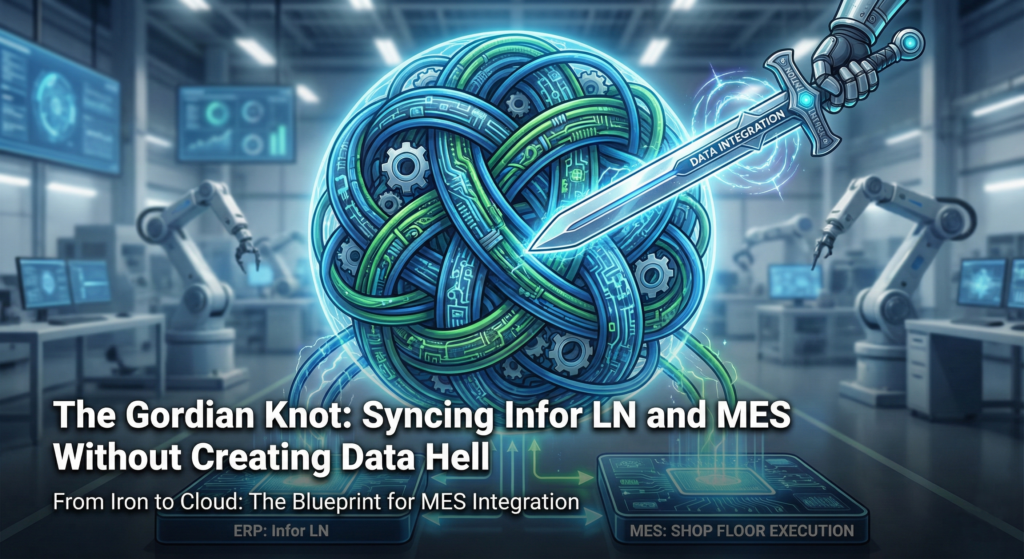
In ancient mythology, the Gordian Knot was an intricate problem that no one could untangle. Alexander the Great famously solved it by cutting it in half with his sword.
In the modern manufacturing landscape, the integration between your ERP and your MES is that knot. But unlike Alexander, you cannot just hack away at it with a sword – unless you want to corrupt your General Ledger and paralyze your production line.
In Part 1, we established that the ERP plans the strategy while the MES executes the reality. Now, we must build the secure communication line between the General and the Lieutenant. This is where 80% of digitalization projects face delays: not in the software installation, but in the synchronization logic.
Rule #1: The Sovereignty of Master Data
Before we send a single Production Order, we must agree on the laws of the land.
The most common cause of failure I see in my consulting practice is a Master Data Anarchy, where the MES allows users to perform actions you can’t usually perform in the ERP.
To avoid a Data Hell, you must enforce a strict hierarchy: Infor LN is the Single Source of Truth.
The MES is a subscriber, not an author, for the following data structures:
- Items: the Part Number, description, and unit of measure are sacred.
- Bill of Materials: what we are building.
- Routings: how we are building it (Operations, Work Centers, Cycle Times).
Why is this distinction critical? We must address this because many commercial MES platforms offer the capability to maintain standalone tables for data that typically belongs to the ERP domain, such as BOMs and Routings. Technically, they can operate independently.
However, without adequate integration – or a clear strategic decision on “who passes data to whom”, this creates dangerous redundancy.
In the worst-case integration scenarios, this duality turns into a disaster where the shop floor is building based on a MES Recipe while Finance is costing based on an ERP BOM, and the two never match.
When Everything Goes Right
The standard integration flow is deceptively simple. We can call it “Happy Path.”
- Release: the planner reviews the schedule in LN and releases the Production Order.
- Trigger: this status change triggers an Infor ION workflow.
- Transport: ION generates a Business Object Document (BOD) – typically the SyncProductionOrder, and pushes it to the MES via a connector (Rest API or JMS).
- Execution: The MES receives the JSON/XML, creates the order in its local database, and waits for the operator to press “Start.”
It looks easy on a PowerPoint slide. But in production, the Happy Path happens about 60% of the time. The other 40% is where the nightmare begins.
Handling Change
The true test of an integration architecture is not how it handles creation, but how it handles modification.
Imagine this scenario:
- 08:00 AM: you send Order #1001 to the MES for 100 pieces.
- 09:00 AM: the MES operator starts the machine.
The status in MES moves to In Progress. - 09:15 AM: an urgent Engineering Change Order (ECO) comes in.
The Engineering team changes a component in the BOM in Infor LN to fix a quality issue. - 09:30 AM: Infor LN triggers a new SyncProductionOrder BOD with the update.
What happens now?
This is the Gordian Knot. If your integration is naive, the MES might try to overwrite the running order, potentially resetting the counter of pieces already produced (wiping out the WIP).
Alternatively, the MES might reject the update because the order is locked, leaving the operator producing 100 pieces with the wrong (old) component.
Update vs. Cancel/Replace
To solve this, you need to understand the language of OAGIS (the standard used by Infor ION).
The SyncProductionOrder BOD carries an ActionCode, which specifies the exact operation (Add, Change, Delete, or Replace) the system must perform on the order
Your MES middleware must be smart enough to parse this:
- Check Status: Is Order #1001 running in the MES?
- If Running: STOP. Do not apply the update automatically. Raise an alert to the Shift Leader.
- If it’s not Running: the MES accepts the incoming update from Infor LN (where the material change was made) and aligns its local Estimated Materials list.
Some MES platforms do not support Delta Updates (changing just one line). They require a Cancel & Replace logic (Delete Order A, Create Order B).
This is dangerous if work has already started.
You must map this logic during the Blueprint phase.
The Read-Only Doctrine
Having some years in integration projects, I tend to have strict rules to avoid future issues.
For example, once a Production Order is flagged as Started in the MES, it becomes Read-Only in Infor LN.
You should configure Infor LN to grey out critical fields (e.g. quantities) when the integration status is Sent to Mes (this can be a small CDF – Custom Defined Field – inside LN Production order’s header to give users a visual understanding of what has been already integrated into the MES).
If you absolutely must change an order that is currently being cut on the CNC machine:
- Stop the Machine.
- Close the Order in the MES (report partial quantity produced so far).
- Close the Order in Infor LN (technically “Complete” the partial quantity).
- Create a New Order in LN for the balance with the new engineering revision.
This will be sent again to the MES to continue the work.
Is it bureaucratic? Yes. Does it annoy the planners? Absolutely. Does it ensure that your inventory costs and component traceability are 100% accurate? Guaranteed.
Leveraging the Technology Stack
In the Infor ecosystem, we don’t need to write custom scripts to manage this traffic. We use the tools available:
- Infor ION: It queues the messages. If the MES server is down for maintenance, ION holds the BODs and retries later. You never lose an order.
- Infor IDM (Document Management): attach the drawing PDF to the Production Order in LN. The BOD sends the link to the MES. The operator views the drawing directly on the touch panel. No paper.
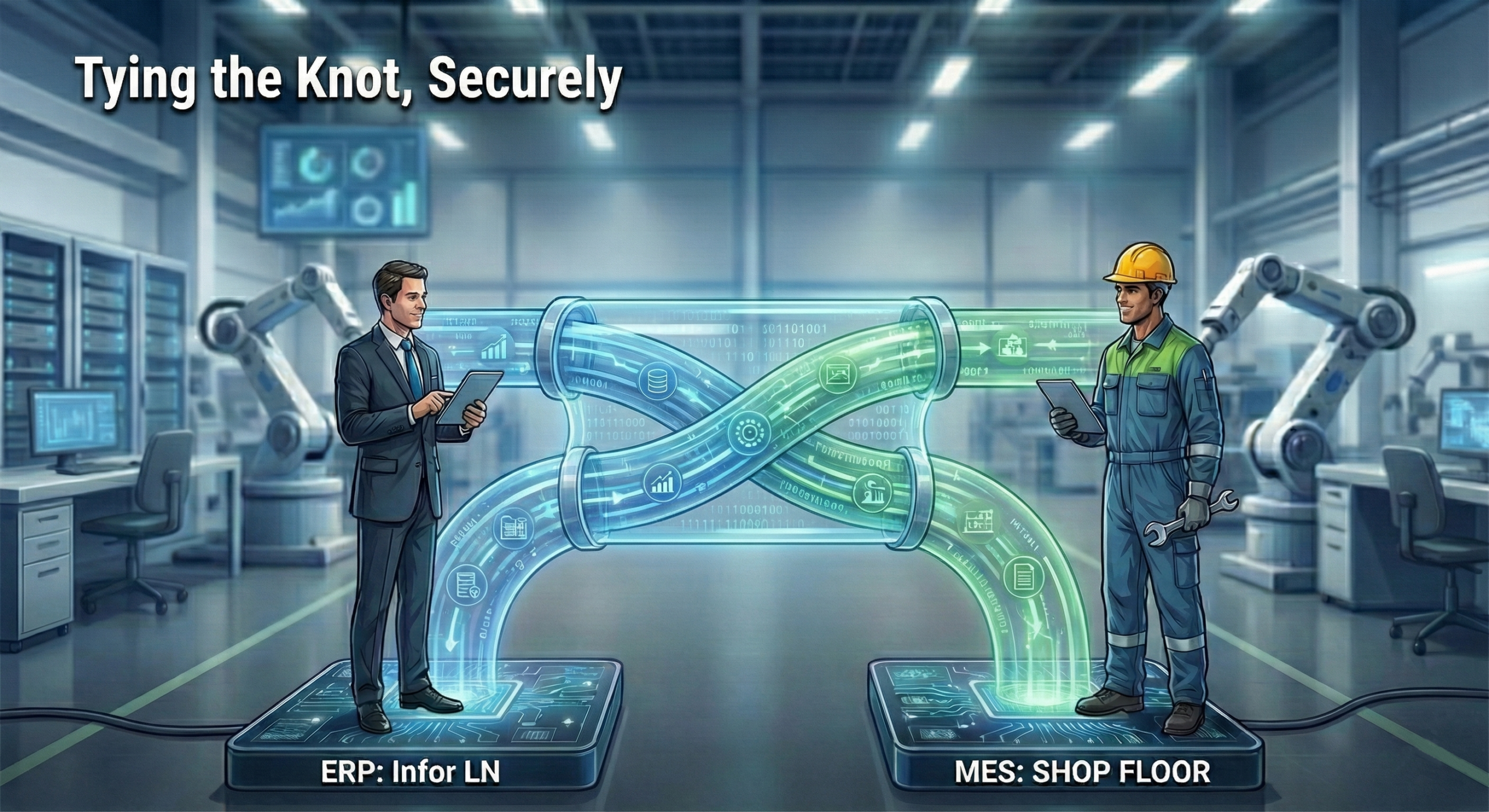
Tying the Knot, Securely
Integrating Infor LN with an MES is an operational discipline project.
The code is the easy part.
The hard part is teaching your organization that they can no longer fix things on the fly without following a digital protocol.
In the next article, we will leave the office and go down to the machine level.
We will examine how we extract those signals from the PLCs (OPC-UA, Modbus) to feed the MES in the first place.
Written by Andrea Guaccio
February 04 2026