

Machines Don’t Speak HTTP. They Speak Voltage and Registers
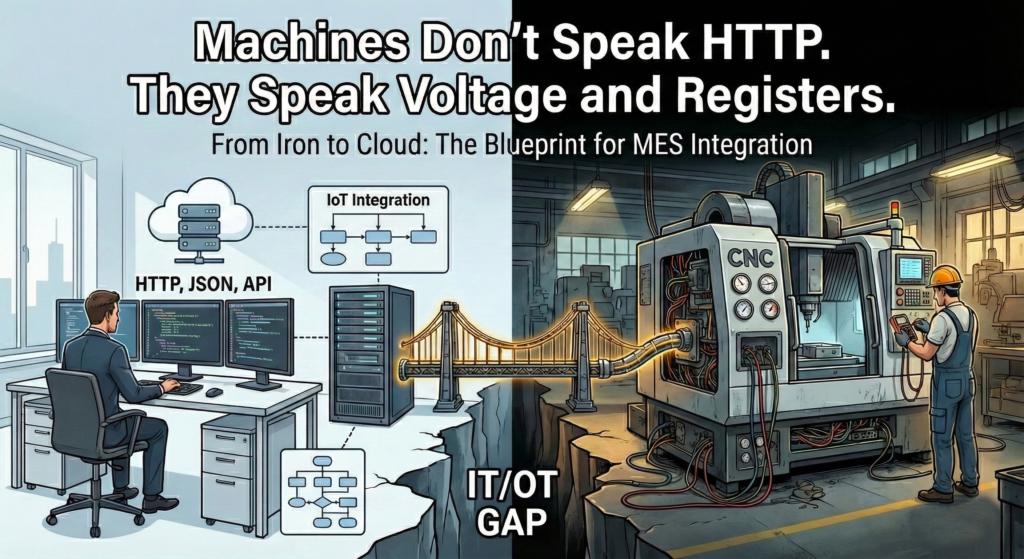
We have talked about Strategy (ERP). We have talked about Execution (MES).
Now, we must talk about the Iron and what it truly takes to achieve Infor LN shop floor connectivity.
For a Solution Architect sitting in a comfortable office, connecting a machine to Infor LN sounds like a simple flowchart box labelled IoT Integration.
But down on the shop floor, the reality is brutally different.
Your CNC machine does not have a REST API. It does not return a JSON payload. It does not know what “Authentication Bearer Token” means.
It speaks the language of physics: voltage, closed circuits, and memory registers.
This is the IT/OT Gap (Information Technology vs. Operational Technology).
Bridging this gap is the physical foundation of any digital factory.
The Language Barrier: Why We Need a Translator
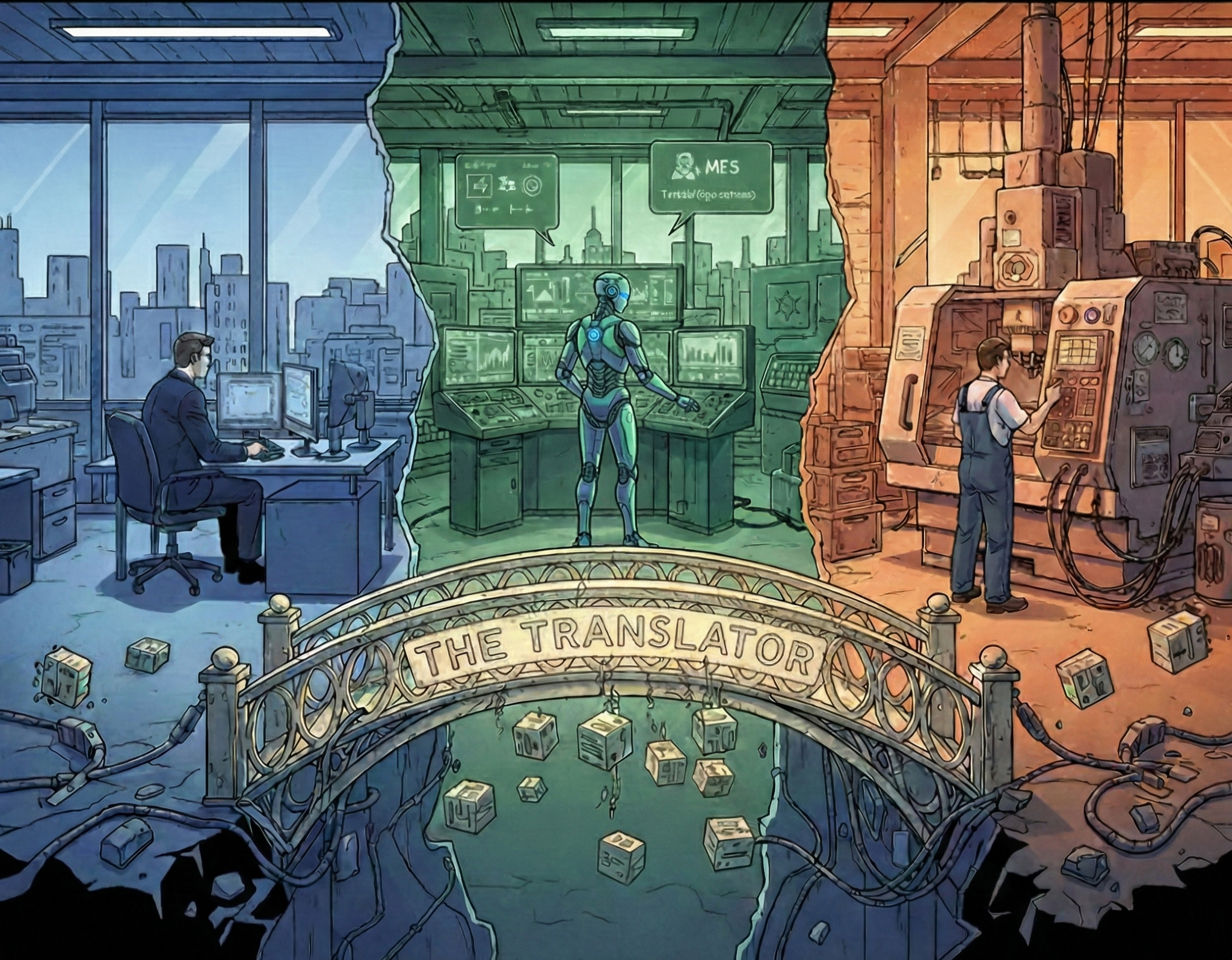
If Infor LN speaks English (Business Logic) and the MES speaks Tactical (Operations), the machine speaks Binary.
To get a “Production Count” from a stamping press, you are reading a voltage signal from a PLC (Programmable Logic Controller) that turns on and off every time the mold closes.
We cannot plug this wire directly into the Cloud.
We need a Translator.
In the industry, we call this the Edge Gateway or Connectivity Layer.
The Protocol Zoo
Before data reaches your beautiful dashboard, it travels through industrial protocols that were invented before the Internet existed.
Here are the “beasts” you will encounter in the wild:
- Modbus TCP: Invented in 1979. It is the Latin of the factory. It is simple, insecure, and dumb. It reads data in “Registers” (e.g., Register 40001 = Temperature). It is still used everywhere, from energy meters to legacy pumps.
- Siemens S7 / Omron FINS: If your factory is in Europe, you likely run on Siemens (S7-1200/1500). If you are in Packaging, you might see Omron or Beckhoff. These protocols are fast and robust but proprietary.
- OPC-UA : Open Platform Communications Unified Architecture. This is the modern standard we all pray for. It is secure (encrypted), semantic (it tells you “This is a Temperature” not just “40001”), and platform-independent.
The Architecture: From Bit to Byte to Business
So, how does a vibration on a motor become a transaction in Infor LN? Here is the data path:
- The Source (PLC): The machine controller detects a fault. It flips a specific bit in its memory from 0 to 1.
- The Translator (Edge Gateway): A software like Kepware or a hardware gateway (Telit, HMS) polls the PLC every 100 milliseconds. It sees the bit flip. It translates “Bit M10.2 = 1” into a readable message: “Machine_Status = Alarm”.
- The Transport: The Gateway wraps this message in a lightweight packet and publishes it to the MES server or the IoT Broker.
- The Context (MES): The MES receives Alarm. It looks up who is working on that machine.
It contextualizes the raw signal: “Order #1001 is stopped due to Spindle Error.” - The Business Update (Infor LN): finally, the MES sends a BOD or API call to Infor LN to update the machine status to “Down” inside the Machine Time-Out session.
The planner sees the capacity changing in real-time.
Signal vs. Noise
The biggest mistake I see in IoT projects? Data Gluttony.
Engineers get excited and try to stream every single tag from the PLC to the Cloud. They want to record the temperature every second, the vibration every millisecond, the motor amperage every cycle.
Do not do this.
Streaming raw telemetry directly into your ERP or a standard SQL database doesn’t add any value.
Remember that ERPs like Infor LN are designed to handle business transactions, not Time-Series streams with billions of rows.
Filter at the Edge.
- The Machine generates 1 TB of data per day (High Frequency).
- The Edge Gateway analyzes it and calculates the average every minute.
- The MES records the Shift performance (Medium Frequency).
- Infor LN receives only the Exceptions (Low Frequency): “Job Started,” “Job Finished,” “Machine Down.”
Keep the noise on the floor. Send the signal to the boardroom.
The Foundation is Laid
We have defined the roles (Part 1).
We have tied the knot between ERP and MES (Part 2).
We have connected the machines to the network (Part 3).
But the factory of 2026 is not just about connected machines.
It is about intelligent machines.
In the final chapter of this series, we will look at the future.
We will explore The Cognitive Factory: how AI, Generative Agents, and ESG goals are transforming the MES from a passive recorder into a proactive assistant. From What happened? to What should we do?
Written by Andrea Guaccio
February 11 2026