

Strategic Foundations: Choosing Your Poison
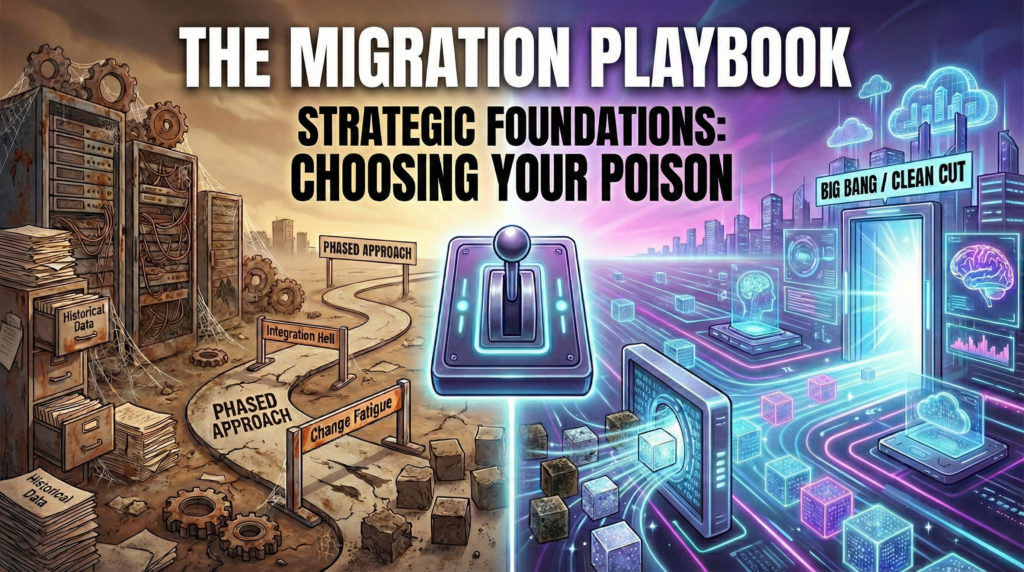
Part 1 of series The Migration Playbook: From Legacy Chaos to AI-Ready
In the world of high-stakes ERP consulting, there is a saying that everyone should repeat every Steering Committee: Go-Live is not a ceremony, but a surgery.
And just like surgery, the patient’s survival depends entirely on the preparation, the team’s skill, and the strategic choices made long before the first incision.
Across all these years of ERP transitions, specifically within the ecosystem of Infor LN, I have seen projects succeed brilliantly because leadership made hard, uncomfortable choices in the blueprint phase. Conversely, I have seen projects bleed money and morale for years simply because they tried to “play it safe” with the wrong strategy.
Welcome to The Migration Playbook.
This 6-part series It’s a survival guide designed for all those professionals who are tasked with the monumental job of migrating from a legacy system to a modern Cloud ERP without destroying the business in the process.
We start today with the most critical decision of all, the one that sets the trajectory for the entire project: the strategy.
The Illusion of Safety: Big Bang vs. Phased
The first question in every kick-off meeting is inevitable: “Should we go Big Bang or Phased?”
To answer this, let’s strip away the jargon and look at what these strategies actually mean in the real world.
In Simple Terms: The Metaphors
- The Big Bang Imagine moving houses. On Friday, you pack everything into a truck. On Saturday, you move. On Sunday, you unpack. On Monday morning, you wake up, eat, and sleep in the new house. You hand over the keys to the old place immediately. There is no going back.
- The Philosophy: “Rip the band-aid off.” It’s an all-in switch where the legacy system is turned off, and the new ERP goes live simultaneously across all departments.
- The Phased Approach Imagine renovating your home while living inside it. First, you redo the kitchen (Finance), but you still sleep in the old bedroom (Production) and use the old bathroom (Warehouse). You live in a construction site for months, constantly moving between new and old rooms.
- The Philosophy: “One step at a time.” You migrate by module (e.g., Finance first) or by site (e.g., Plant A, then Plant B), keeping both systems active for a transition period.
There is no “right” or “wrong” here, only what works for your specific risk profile. However, each choice comes with a price tag.
Option A: Big Bang
- Why choose it: From Day 1, Finance, Sales, and Production see the exact same data. There is no gap. No Temporary Interfaces: You don’t waste budget building bridges between the old and new systems. Psychological Break: It forces the organization to adapt immediately. No one can cling to the old ways because the old ways are gone.
- The Risks: If the system fails on Monday, the entire company stops. You cannot ship, you cannot bill. It is high-stakes poker. Peak Stress: The go-live period is intense. The organization is under maximum pressure for at least 2-3 weeks.
Option B: Phased
- Why choose it: if Finance has issues, the Factory keeps running on the old system. You don’t bet the whole farm at once. Learning Curve: the team learns from the first phase, making subsequent rollouts smoother. Lower Acute Stress: effort is spread over time, avoiding the “pressure cooker” of a single weekend.
- The Risks: to make the new Finance module talk to the old Manufacturing system, you must build complex, expensive interfaces that you will throw away later.
- Skyrocketing Fees: you avoid double entry by building automated integrations, but someone has to design, build, and monitor them. This keeps high-cost consultants on the payroll for years instead of months, significantly inflating the project’s Total Cost of Ownership.
- Change Fatigue: The project drags on for years. People get tired of living in “transition mode.”
Context is King
So, which one should you choose?
There is no absolute “My Advice” here and beware of any consultant who tells you otherwise. There is only the specific reality of your company at this specific moment in time.
The decision comes down to a trade-off between Risk Concentration and Organizational Maturity.
- The Big Bang asks: “Are you willing to risk everything in a single weekend to be done quickly and cleanly?”
- The Phased Approach asks: “Are you willing to pay more and endure a longer timeline to guarantee a higher probability of success?”
This second point is crucial. We often forget that while consultants do this for a living, your internal teams – the Accounting Manager, the Warehouse Supervisor – have likely never faced a transformation of this magnitude.
For an inexperienced team, a Phased approach (despite the higher cost) allows them to measure themselves against the challenge gradually. It prevents the organization from snapping under the pressure of a total switch-off. It buys you the most valuable asset of all: Confidence.
The History Trap: We Need Everything
Once the strategy is set, the next battleground is Data Scope. This is where the psychology of hoarding clashes with technical reality. The users will plead: “We need to migrate all historical data. I absolutely need to see exactly what I sold to Mario Rossi in 2015 within the new screen.”
Do not do it.
Migrating 15 years of closed transactions (Sales Orders, Invoices, Production Orders) into a new LN Cloudsuite environment is a strategic error that compromises your future.
Here are the three reasons why migrating history can be a liability:
- Technical Debt and The DAL Doctrine
Infor LN uses a strict Data Access Layer (DAL) to validate every record entering the system. Your data from 2010 likely does not meet the validation rules of 2026. Maybe you didn’t require a Country of Origin back then, but now it is mandatory. Maybe your old Units of Measure are obsolete. To migrate that old data, you would have to disable validations or “fake” the missing data, filling your pristine new database with garbage just to make it fit.
- Data Quality vs. Data Volume
Legacy data is inherently dirty. It contains the ghosts of bad processes, cancelled orders that were never cleaned up, and supplier codes that are no longer active. Importing this mass of data means polluting your new system on Day 1. You are effectively moving into a brand-new luxury house and filling it with the dusty, broken furniture from your basement.
- AI Pollution
This is the new risk for the 2020s. If you plan to use Infor GenAI or modern predictive models for supply chain planning, you need clean, consistent patterns. AI learns from history. If you feed it 10 years of obsolete processes – like lead times from the COVID era or pricing models you no longer use – the AI will learn the wrong lessons. It will produce hallucinations rather than insights. To build an AI-Ready ERP, you need a high signal-to-noise ratio. Old data is noise.
Industry Validation: The “Clean Core” Consensus
Don’t just take my word for it. The major players in the enterprise software space have all shifted towards this philosophy to support agility and AI:
- The “Clean Core” Principle: Leading vendors like SAP now explicitly advocate for keeping the ERP core free of legacy clutter to ensure innovation readiness. Read about the Clean Core Strategy
- Legacy Retention Options: Oracle’s official guidance lists keeping the legacy system in “Read-Only” mode as a primary strategy to avoid the risks of over-migration. See Oracle’s Data Retention Options
- AI Prerequisites: Experts agree that AI models require high-quality, relevant data. Migrating obsolete patterns actively harms model performance (“Garbage In, Garbage Out”). Why Data Quality is Critical for AI
- Consultant’s Deep Dive: I have previously analyzed how bad data bankrupts AI agents. If you want to understand the mechanics of “Dirty Data,” check out my article: The AI Killer: Why Dirty Data Will Bankrupt Your Agent
The Clean Cut Strategy
The only professional way to handle a critical migration is the Clean Cut. We migrate only what is alive:
- Active Master Data: Customers and Suppliers who have transacted in the last X years (a timeframe defined with the Client), plus any partner linked to the Open Transactions we are migrating.
- Active Items and BOMs: Only the products we can actually build and sell today.
- Open Sales Orders (Backlog): Orders we still need to ship.
- Open Purchase Orders: Goods we are waiting to receive.
- WIP (Work In Progress): Production orders currently on the floor.
- Current Stock Balances: A precise snapshot of inventory value.
- Other Open Transactions: We migrate any transactional document required for business continuity (such as Service Orders, Projects, or Contracts). The examples listed above are just the most common ones; the rule applies to everything needed to keep the lights on.
Everything else – closed orders, paid invoices, old history- stays behind.
The Look-Up Solution: GenBI and Data Fabric
“But Andrea, how do I answer the customer who asks about an invoice from 2018? Do I tell them I don’t know?”
This is the objection that usually kills the Clean Cut strategy. Users are terrified of losing visibility. But in 2026, we have a better answer than keep the old PC under the desk.
We leverage Modern BI (or GenBI) and Data Fabric architectures.
Instead of bloating the transactional ERP with dead data, we connect a modern BI tool (like Microsoft PowerBI) to two distinct sources:
- The Legacy Database (set to read-only mode) for historical depth.
- The New Infor Data Lake for current, live operations.
We build a unified dashboard that sits on top of both. When a user queries “Sales to Mario Rossi,” the BI transparently merges the 2018 data (from Legacy) and the 2026 data (from LN). The user gets their complete answer in one view. They don’t care where the data sits physically; they only care about the information. This approach keeps your new ERP lean, fast, and completely focused on the future, while still respecting the value of the past.
Want to understand how you can literally “talk” to your legacy data without migrating it? Read my detailed breakdown here: Generative BI: Talking to Your Data
My Final Take
A successful migration is not about moving data; it is about filtering value. It is about having the courage to leave the baggage behind. By choosing a Clean Cut and resisting the urge to phase the project out of fear, you are archiving historical data to pave the way for an AI-Ready future.
In the next part, we will discuss how to prepare this selected data for the move. We will talk about Garbage In, Disaster Out and why a Migration Template is the most powerful psychological tool in your arsenal to enforce data ownership.
Deep Dive: For more on why modern data strategies decouple history from operations, read about the concept of Data Fabric Architecture.
Written by Andrea Guaccio
March 5, 2026