

Open Weights, Closed ERPs: Why Your AI Bill Doesn’t Add Up
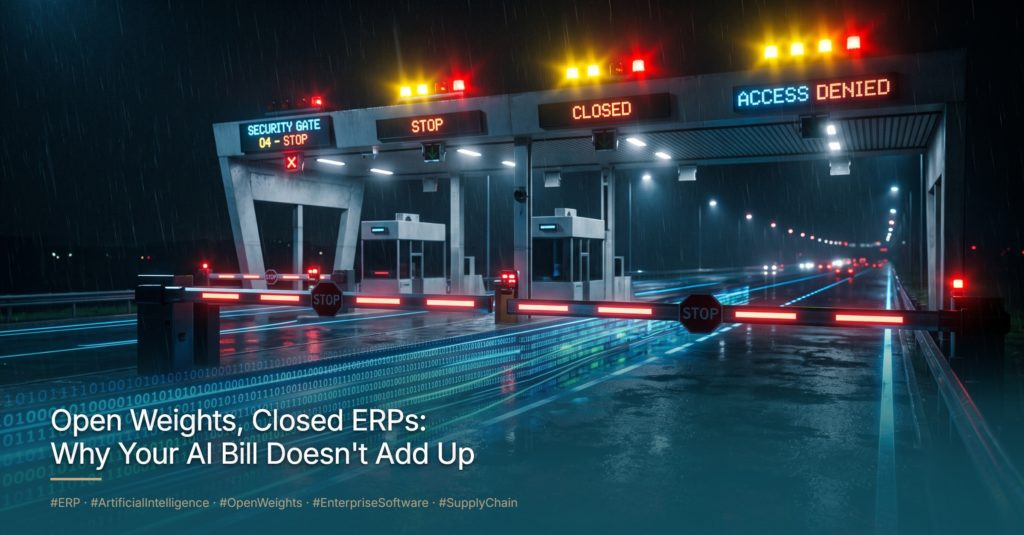
Back in April, DeepSeek released a model that rivals semi-frontier models basically for free. Your ERP vendor is probably charging you extra to use some last year’s version behind a paywall.
To me, something in this equation does not add up.
Training a Large Language Model is an extraordinarily expensive business. The capital required for compute power and talent is staggering.
To protect this investment, some creators have gone to extreme lengths. Anthropic has implemented anti-distillation mechanisms in their models, deliberately generating lower-quality responses if they detect a competitor attempting to clone their reasoning patterns.
For those unfamiliar with the term: in AI, distillation is the process of training a smaller, cheaper model by feeding it the outputs of a larger, more expensive one. Instead of spending millions teaching a model to think from scratch, you train it on the API responses of a frontier engine. A shortcut that clones performance at a fraction of the cost.
On the other side of the globe, Chinese companies that creates models such as DeepSeek, Qwen, and GLM are taking the opposite approach, leveraging this exact shortcut. They release competitive open-weights models alongside detailed academic papers that outline their training methodologies.
Their papers openly document the use of synthetic data generated by Western closed engines to bootstrap their models. By using these outputs to kickstart training, they bypass the astronomical costs of exploratory research.
The motivation is purely strategic, not charitable. These companies understand where this technology is heading.
Some industry observers believe Chinese firms release open-weights models to drive rapid adoption, countering American dominance where GPU export bans constrain domestic training. But I think the reasoning goes deeper than geopolitics. There is a growing thesis, one I find increasingly convincing, that Large Language Models will inevitably become a commodity.
Like relational databases, operating systems, and web hosting, the barriers to access will collapse. When a technology becomes a commodity, the value shifts away from the raw utility itself and toward how it is integrated into specific, real-world workflows.
If this commoditization hypothesis holds true, the current AI market bubble will face a major correction. Yet, the enterprise software sector is moving in the exact opposite direction.
Why Your ERP Vendor Wants to Own Your AI
If LLMs are truly destined to become a commodity, we must ask why the ERP market is trying to lock them behind proprietary walls.
When you buy an AI feature from some traditional ERP vendors today, you are typically buying a closed package. There’s no flexible integration in it. An All-Inclusive stack. The vendor provides their pre-selected models, their usage caps, and their specific API restrictions. It is simply another subscription added to your monthly bill.
For businesses operating in low-margin industries, this variable cost model is a source of concern. Supply chain managers and chief information officers are hesitant to deploy autonomous agents if they cannot predict the monthly cost of a transaction.
Consider a typical warehouse operation for example. If you want to use an AI agent to match incoming supplier invoices with purchase orders and goods receipt notes, you are dealing with thousands of transactions daily. Under a vendor’s closed, token-based pricing, this operational volume becomes risky.
You find yourself pacing usage, restricting access, or turning features off to avoid budget overruns. Worse, you are locked into the vendor’s model family. You cannot route a simple classification task to a lightweight model and reserve the expensive frontier engine for complex exceptions. The model that dominates benchmarks today may be surpassed in three months. If your vendor’s update cycle cannot keep pace, your operations are running on yesterday’s intelligence at tomorrow’s prices.
Before we continue I want to clarify the terminology here. No one is advocating for Open Source ERP. The core transactional logic, the relational database structure, and the financial ledgers of an ERP cannot, and should not, be replaced by an open-weights model.
But why are ERP vendors (so far) refusing to build open agentic architectures?
A pragmatic approach would allow the enterprise to choose. Instead of forcing a proprietary connection, vendors could design systems where the client runs a local model on their own infrastructure or simply inputs their own API key.
This bring-your-own-key approach would immediately shift the financial burden. The enterprise could negotiate its own compute rates, run open-weights models locally for routine tasks, and reserve expensive frontier models for complex exceptions.
The math that doesn’t add up
ERP vendors who attempt to build a business model on reselling token access are building on sand.
If LLMs become a commodity (still an IF to be demonstrated), the cost per token will decline at some point in time. An ERP vendor selling a fixed-price subscription with a built-in markup will find it difficult to justify their pricing when the underlying technology is practically free.
On the other hand, if token costs spike because AI labs fail to amortize their training expenses through economies of scale, the vendor’s financial model collapses from the other side. They will be forced to restructure their licensing fees.
The other possible alternative is worse. They lock clients into cheaper, outdated models to keep pricing artificially stable, leaving the business with a service that is completely behind the curve.
Whichever direction the market takes, this vendor-locked strategy is bound to fail. Most enterprises are already paying for AI in some form, whether through corporate licenses, pilot projects, or shadow AI initiatives that IT does not officially track. The models behind these tools are architecturally similar to the ones some ERP vendor are repackaging.
Both are cloud-hosted, token-based, and drawn from the same family of foundation models. Paying a second, marked-up subscription to access a restricted version of the same capability through your ERP is cost duplication disguised as integration. It is the enterprise equivalent of buying a car but being forced to pay a separate subscription to use a specific brand of fuel that the manufacturer distributes at a premium.
The standard defense for this closed model is data security. Vendors argue that enterprise data must remain within their cloud ecosystem to prevent leaks.
Unfortunately, this argument ignores decades of enterprise architecture history.
For something like thirty years, companies have been extracting master data and transactional records from their ERP systems. They feed this data into external Business Intelligence tools, supply chain optimization engines, and customer relationship management systems. They have built secure pipelines to do so.
Pretending that enterprise data cannot safely interact with an external or local LLM is a fabricated barrier designed to protect a subscription revenue stream. Implement proper agentic grounding, structured output validation, and execution guardrails, and the security argument falls apart.
The Plumbing Is Worth More Than the Water
The enterprise software market will have to adapt. I believe that instead of acting as gatekeepers for third-party models, ERP vendors should focus on building the infrastructure that lets clients plug in any model they choose.
An open-weights model running locally is useless unless it has access to clean, real-time data from the warehouse floor, the production line, and the purchase ledgers. The model is the engine. The data is the fuel.
ERP vendors should focus on building robust, secure API layers and agentic orchestrators that can ingest this data and feed it to whatever model the client prefers. They should be building the plumbing, not trying to sell the water.
Over the next twelve months, we will see which vendors understand this shift. Those who continue to push closed, high-margin AI packages will likely see low adoption rates and frustrated clients. Those who build open, flexible architectures that support local models and external keys will position themselves as the pragmatists of the industry.
We will see how the market matures. But for now, I would rather wait before evaluating closed AI subscriptions, and demand the flexibility to bring my own intelligence to the ERP.
Written by Andrea Guaccio
July 14, 2026