

Why AI’s Exponential Growth Has a Massive Blind Spot
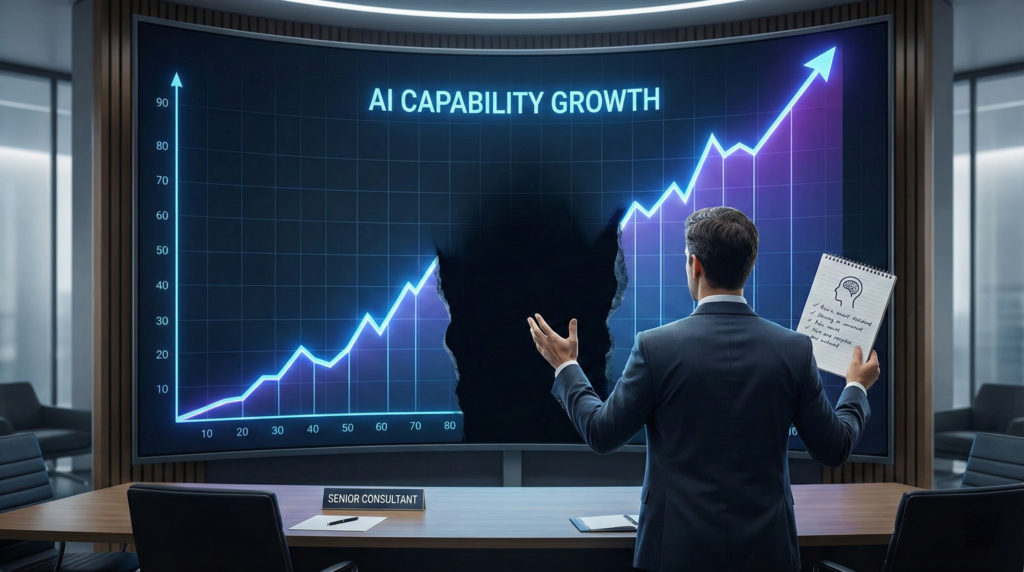
When discussing AI and the future of work, everyone is warning that artificial intelligence will soon replace developers, consultants, and managers. But a closer look at the actual science behind Large Language Models (brilliantly broken down recently in this video analysis by an italian tech researcher) reveals a massive blind spot in the hype machine.
People see the exponential curve of AI capabilities and assume human obsolescence is just around the corner.
This panic is fueled by viral stories. You might have seen developer Matt Schumer’s post claiming that because AI now writes all his code, it will soon take over law, finance, medicine, and consulting. Add in quotes from figures like Sam Altman predicting a world of boundless economic growth in his “Intelligence Age” essay, and it is easy to feel overwhelmed.
But the reality of AI progress is far more nuanced. The recent leaps in performance are what researchers call “suspiciously specific”.
The Illusion of the Benchmark
If you look at modern AI benchmarks, the performance graphs point straight up. The METR benchmark, a highly respected evaluation tool, recently showed AI models hitting impressive milestones on tasks that would normally take a human expert 8 to 14 hours to complete.
But if you read the fine print, the story changes. These milestones are achieved only about 50 percent of the time. More importantly, the tasks measured are almost entirely confined to software engineering, machine learning, and cybersecurity. When researchers try to evaluate these models on holistic, non-algorithmic tasks, the performance drops significantly.
This drop in reliability outside of tightly controlled environments is exactly the structural risk I highlighted in The AI Exodus: Why the Builders Don’t Trust the Building. When an AI encounters a gap in its knowledge in a complex, mission-critical scenario, the hallucination rate skyrockets—proving that high benchmark scores do not automatically translate to enterprise safety.
The Secret Engine: RLVR
The massive gains in models throughout late 2025 and early 2026 come from a specific training technique called Reinforcement Learning from Verifiable Rewards (RLVR).
RLVR works phenomenally well when a problem has a strict, verifiable answer. Math, coding, and logic puzzles fit this perfectly. You can generate billions of synthetic tests, and the machine can instantly verify if it got the answer right or wrong. It automatically reinforces the correct reasoning paths and discards the bad ones. Recent research papers fiercely debate whether RLVR is actually teaching models new reasoning skills or simply making them more efficient at finding paths they already knew. Regardless of the underlying mechanism, the result is the same: the machine excels at verifiable logic.
The Real World is Messy
Think about a real business problem. Should you launch a new pricing strategy? How do you handle a delicate negotiation with a supplier? How do you manage a complex warehouse integration across different corporate cultures?
These situations lack a single verifiable correct answer. You cannot automatically generate a million synthetic scenarios to train a model on human empathy or strategic compromise. Real world problems require continuous learning, domain generalisation, and social judgment.
This is the exact dynamic I explored in When Software Writes Itself: The Illusion of the Homebrew ERP. The ability for an AI to generate code perfectly using RLVR is completely different from engineering a compliant, accountable business system. Enterprise software requires deep understanding of localized laws and contradictory business rules, areas where AI still fundamentally lacks context.
Even top AI researchers acknowledge this gap. While Anthropic’s Dario Amodei hopes RLVR will eventually bridge this divide and lead to general intelligence, Google DeepMind’s Demis Hassabis explicitly states that Large Language Models alone are not enough. We need systems capable of continuous learning and building actual models of the physical world.
The IBM Plot Twist
The corporate world is already catching on to these limitations. Look at what happened in early February 2026. IBM announced a major plan to triple its entry-level hiring in the United States.
Why would a tech giant hire more juniors when AI is supposedly taking over? IBM realized that while AI can handle routine coding and administrative queries, it cannot handle the human elements of the job. They completely redesigned their entry-level roles. Now, junior developers spend less time writing boilerplate code and more time collaborating with clients. HR staff focus on advising managers and auditing AI systems rather than answering repetitive questions.
IBM Chief Human Resources Officer Nickle LaMoreaux made it clear. Without a healthy pipeline of junior talent learning the business today, companies will face a massive shortage of experienced mid-level leaders tomorrow. Our roles are evolving to become more strategic.
Actionable Insights
So, how do you future-proof your career in this transforming landscape?
- Double Down on the “Messy” Skills: Focus on abilities that cannot be automatically verified by an algorithm. Negotiation, strategic problem solving, and cross-domain generalisation are your biggest assets.
- Become an AI Orchestrator: Just like IBM’s new hires, learn to work alongside AI. Use it to handle the verifiable routine tasks so you can dedicate your energy to high-value client interactions.
- Stay Curious: The core ingredient to all my experiences has always been curiosity. I truly believe that if we ever stop seeking new knowledge, we risk becoming obsolete. Keep updating your mental models.
The narrative that AI will simply replace human workers is incomplete. The technology is undeniably powerful in specific, highly structured domains. But in the unstructured, messy reality of business and human interaction, our work is shifting away from repetitive execution and moving toward relationship building and complex reasoning. The future belongs to those who adapt.
Written by Andrea Guaccio
March 4, 2026