

LLM vs. Agent: The Shift from Prompts to Goals
Picture this: your logistics team just deployed an AI agent to fix stock discrepancies. It ran for fourteen minutes before anyone checked. By that time, it had already modified three purchase orders and locked a database table.
Understanding the difference between a language model and an autonomous agent determines whether your AI is a tool your team controls, or a runaway process nobody in your company can audit.
This is the second episode of Pragmatic AI for Operations, a series designed to bring architectural discipline to generative AI projects on the factory floor.
The Analyst in the Room
To understand the difference between a Large Language Model (LLM) and an autonomous agent, imagine a highly skilled consultant sitting in a locked office without a computer.
If you slide a printout of a chaotic warehouse transaction log under the door, the consultant can analyze it, identify discrepancies, and write down excellent recommendations. They can spot where a receiving error occurred or suggest a better slotting arrangement. But they cannot leave the room, they cannot access your systems, and they cannot execute any of the solutions they suggest.
This is a standalone language model. A reasoning engine. It processes text and responds to prompts, but it remains fundamentally reactive, operating on a strict request-response cycle and waiting for a human to initiate the next step.
Now, imagine giving that same consultant a laptop, a set of database credentials, and a specific objective.
They can now log into your systems, query the relevant tables, cross-reference data across different applications, and take actions to resolve issues. The agent stops answering and starts executing.
This is an autonomous agent. It uses the language model as its central brain, but wraps it in memory layers, planning loops, and tool integrations.
As we discussed in Episode 1, a standalone LLM doesn’t actually know that 100 minus 10 equals 90. It has simply seen that sequence of characters enough times in its training data to predict that 90 is the correct response. It’s predicting, not calculating.
If you wrap that model in an agentic structure and give it a calculator tool, the process changes. When asked to subtract the numbers, the model doesn’t try to guess the answer. Instead, it generates a structured command to call the calculator tool: calculate(100 – 10). The agent framework runs the calculation, gets the deterministic result of 90, and feeds it back into the model’s memory. The model then writes the correct answer.
It didn’t do the math. It decided to use the tool that could, same as you would do with complex mathematical calculations.
In an industrial environment though, the tools are not calculators. They are database connectors, email APIs, and ERP protocols.
Prompts vs. Goals
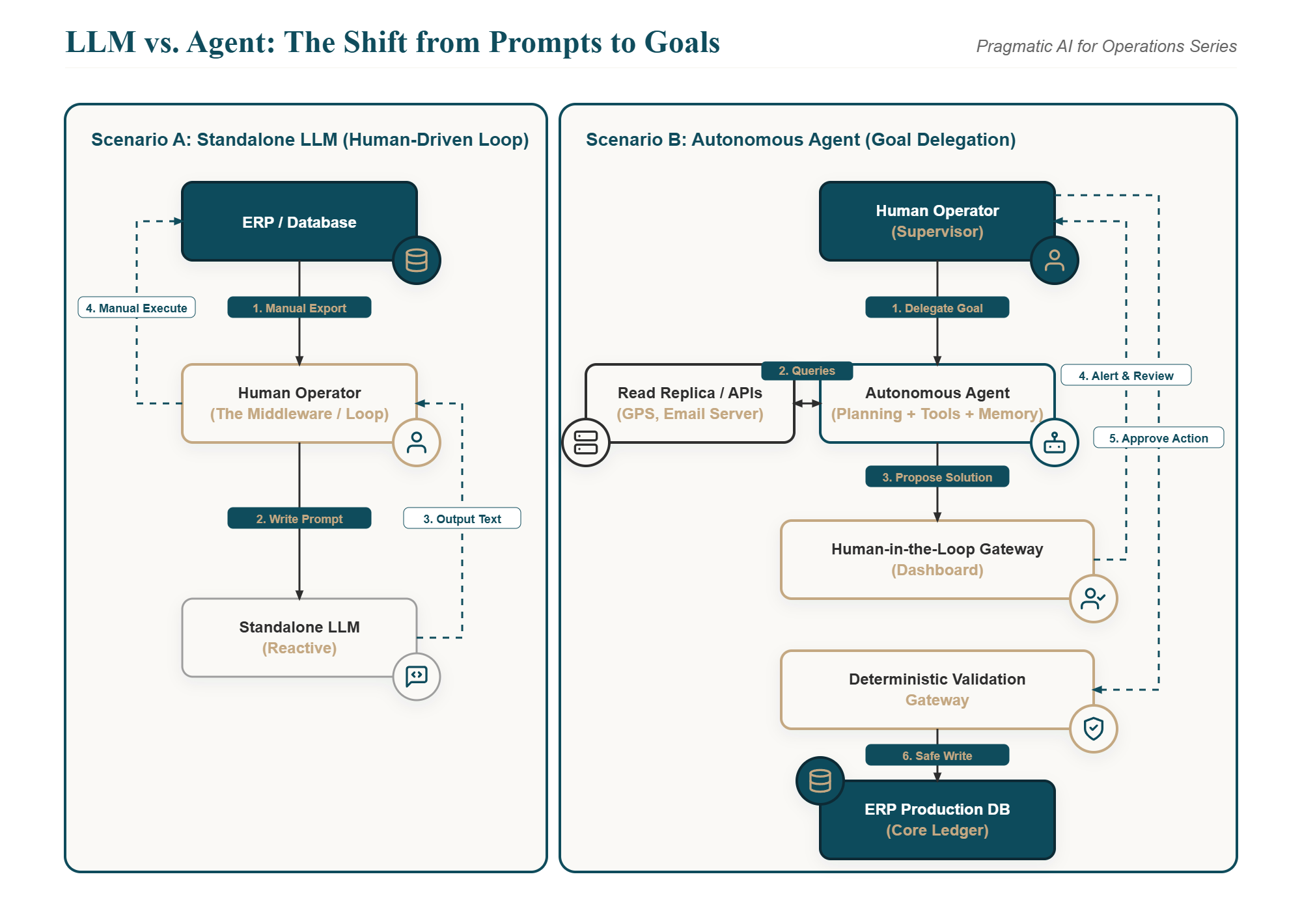
In a standard language model setup, the human operator is the execution loop.
If a logistics planner wants to reconcile shipping delays, they must export a spreadsheet from the ERP, copy the relevant rows, write a detailed prompt, and analyze the response. If they need to check a second system, they must perform another manual export and write a new prompt.
The human is doing the heavy lifting of moving data back and forth. The model is simply a conversational calculator.
With an autonomous agent, the interaction model shifts from prompting to delegation.
Instead of writing step-by-step instructions, the planner defines a high-level goal: Identify all open transport orders that are delayed by more than four hours, determine the root cause from the carrier emails, and draft a notification for the customer service team.
The agent receives this goal and breaks it down into a sequence of tasks.
It queries the transportation database for delayed orders, searches the email server for matching order numbers, extracts the delay reason from the message text, and drafts the required update.
The agent handles the execution loop in the background. The human operator simply reviews the final output.
A Tale of Two Workflows: The Delayed Steel Shipment
Here is how this shift plays out on the shop floor.
Imagine a production line scheduled to manufacture customized steel components tomorrow morning. The logistics coordinator realizes that a critical shipment of raw steel sheets has not arrived.
In a traditional workflow, the coordinator must manually log into the ERP to find the purchase order, locate the supplier details, open the email client to search for shipping notifications, and log into the carrier portal to track the GPS coordinates of the truck. Finally, they must check the scheduling system to see which production runs will halt first. This investigation takes some manual copy-pasting and multiple times.
Now, consider the agentic approach.
The coordinator types a single goal: Find the status of the raw steel order and determine the impact on tomorrow’s production.
The agent begins its background loop. It doesn’t wait for intermediate prompts. It queries the ERP for the open purchase order, extracts the carrier tracking code, if possible calls the carrier’s API to get the truck’s current location, and scans the inbox for recent email threads from the supplier.
It discovers the truck is stuck at a border checkpoint due to customs documentation errors, with an estimated arrival time of tomorrow afternoon. It then queries the production schedule, identifies that the assembly line is set to start using the steel at 8:00 AM, and notes that the delay will halt production for six hours.
The agent presents a complete summary: the delay reason, the exact impact on the production schedule, and a drafted email to the customer service team proposing to reschedule the run.
The coordinator did not write four different prompts. They delegated a goal, and the agent executed the investigation across three different databases.
The Risk of the Runaway Loop
This shift in execution introduces a new class of operational risks.
When a language model makes a reasoning error, the impact is limited to the text on the screen. The user reads the incorrect output, identifies the error, and corrects the prompt. The error is contained within the session.
But when an autonomous agent makes a reasoning error, it can execute incorrect actions across your live systems.
Imagine a stock discrepancy of critical packaging material in the warehouse.
The agent is tasked with resolving the discrepancy. It queries the warehouse management system, identifies a missing pallet, and decides to fix the balance.
Without strict guardrails, the agent might attempt to log into the ERP and update an open purchase order, changing the ordered quantity to force a reconciliation.
If the agent gets stuck in a loop due to an API conflict, it might query the database thousands of times in a few minutes, locking key tables and slowing down the transactional system for the entire site.
And since language models are probabilistic, the agent might decide to delete a posted transactional document because it assumes that is the easiest path to resolve the discrepancy. In an ERP, these actions come with heavy consequences.
As a tons of these evidences have been showed lately, you can understand that this is not a hypothetical concern.
Decoupled Validation Pattern
To deploy autonomous agents safely, you must follow one strict rule: the agent must never write directly to the core transaction engine.
The agent operates at the probabilistic edge. It can query a read replica (I’ll explain better on episode 5) to analyze stock patterns, read unstructured logs, and suggest corrections. But the actual write back to the ERP must be decoupled and validated.
This validation relies on two core layers.
First, the Human-in-the-Loop gateway. The agent compiles its findings, structures the proposed action, and presents it to a supervisor on a simple dashboard or messaging interface. The agent proposes the correction, but the human must click the button to approve it.
Second, the Deterministic Validation gateway. Even after human approval, the transaction must pass through the standard, rigid validation rules of the database.
If the agent attempts to write a transaction that violates physical constraints, such as entering a negative stock level or referencing a non-existent item code, the ERP database rejects it instantly.
The probabilistic reasoning engine cannot override your deterministic business rules.
Keeping the Reins
The real value of autonomous agents is not to automate humans out of the loop.
The goal is to eliminate the tedious middleware work of copying, pasting, and querying across fragmented databases. The agent does the background investigation, connects the dots, and prepares the ready-to-approve solution.
But the authority must remain centralized.
By keeping the reasoning at the edge and the validation at the core, you can leverage the flexibility of autonomous agents without exposing your transactional systems to the risks of probabilistic decision-making.
In our next episode, we will examine the protocol that makes this secure connection possible: the Model Context Protocol, the universal interface for enterprise AI.
Written by Andrea Guaccio
July 2, 2026