

The Algorithm Auditor: The New Role of the ERP Expert
(Part 5 of the series: “The ERP Intelligence Evolution: From Data to Agents”)
In Part 1, we defined the technology. In Part 2, we learned to talk to data. In Part 3, we exposed the risks of autonomy.
In Part 4, we secured the perimeter with clean data.
Now, we face the final, most personal question of this evolution. If the Agent monitors the stock, if GenBI answers the questions, and if the system executes the transactions… what is left for us?
There is a fear lurking in many organizations, often whispered in a hushed tone: “Will this replace me?”
The answer is no.
But it will irreversibly change you.
And for many, that change will feel like an identity crisis.
In a previous article (The Evolution of the ERP Consultant), I argued that the technical Infor LN consultant must evolve from a Code Writer to a Process Orchestrator.
The exact same shift is now happening to the Business User.
We are moving from the era of Data Entry to the era of Algorithm Auditing.
The Death of the Doer
For thirty years, an ERP expert (whether a Super User, a Planner, or a Consultant) was defined by their speed and accuracy in execution.
We all know that person. The Keyboard Hero who knows every shortcut in Infor LN. The one who can load a massive Bill of Material manually in record time. Their value was measured in keystrokes per hour.
In the Agentic future, this skill set becomes instantly obsolete.
The “Supply Chain Agent” doesn’t need you to type the PO.
It types it faster, without typos, linked perfectly to the contract, and it can do 500 of them in the time it takes you to sip your coffee.
The brand new World Economic Forum’s Future of Jobs Report 2025 leaves no doubt.
It forecasts that while 170 million new “tech-enabled” jobs will emerge, 92 million traditional roles will be displaced.
At the top of the Displaced list are Clerical and Data Entry roles.
If you try to compete with the AI on volume or speed, you will lose.
The “Doer” (the operator who adds value solely by moving data from paper to screen) is dead.
The Birth of the Auditor
So, if the AI does the “doing,” what does the human do? The human does the “checking.” But this isn’t just checking for typos.
A key paper from Harvard Business School published in December 2024 (Displacement or Complementarity?) creates a crucial distinction:
- Automation-Prone Tasks: Routine execution (Data Entry).
Demand for these is collapsing. - Augmentation-Prone Tasks: Complex decision making.
Demand for these is skyrocketing.
But there is a trap.
Earlier studies (BCG, Navigating the Jagged Technological Frontier) warned us that humans using AI often “fall asleep at the wheel,” blindly trusting the machine.
The Gartner 2025 Workforce Trends report identifies this Expertise Gap as a top risk: as AI does more, junior employees lose the chance to learn the basics, making them unable to spot errors.
This is the essence of your new role.
You must be the expert who stays awake.
Imagine the Agent suggests: “Switching 50% of the raw material order to Supplier B due to a predicted risk of delay at Supplier A.”
A Doer would just click Approve.
An Algorithm Auditor stops and investigates the logic:
- Context Check:
- Does the AI know that Supplier B is currently in a labor strike negotiation?
- Probably not. That information is in the news, not in the tccom tables. The AI optimizes for the data it has; you optimize for the reality you live in.
- Strategic Check:
- Does this switch hurt our long-term volume rebate with Supplier A?
- The AI might satisfy the immediate need (delivery next week) but fail the strategic goal (year-end bonus).
You are the guardian of the long-term relationship.
The Three New Skills of the Human-in-the-Loop
To survive and thrive in this upcoming Infor CloudSuite era, the skillset must shift dramatically.
We need less muscle memory and more mental agility.
- From How to Why (Causality Analysis)
In the future, you don’t need to know the session code.
You need to know why the pricing engine calculated that specific margin.
When the Agent proposes a discount to close a deal, you must understand the causality.
Did it drop the price because the stock is aging? Or because it “hallucinated” a competitor’s offer? If you can’t explain the result, you cannot approve the action.
The “Black Box” is not an excuse; understanding the logic is your job.
- Exception Management (The 80/20 Rule)
Agents are designed to handle the Happy Flow, the standard 80-90% of transactions that fit the rules.
The human exists for the Edge Cases.
- The urgent prototype that isn’t in the item master yet.
- The favor for a VIP client that violates standard credit limits.
- The complex return with damaged goods and missing paperwork.
- The Guardrail Architect
In Part 3 we discussed Orchestrated Control.
Who sets the rules? You do.
The human role evolves into setting the parameters of freedom.
You are the one who tells the Agent: “You can auto-approve POs up to $5,000 for Office Supplies. But for Raw Materials, or anything above $5,000, you must come to me.” Designing this governance, deciding where the machine stops and the human begins, is a high-level strategic skill.
You are designing the safety net for your company.
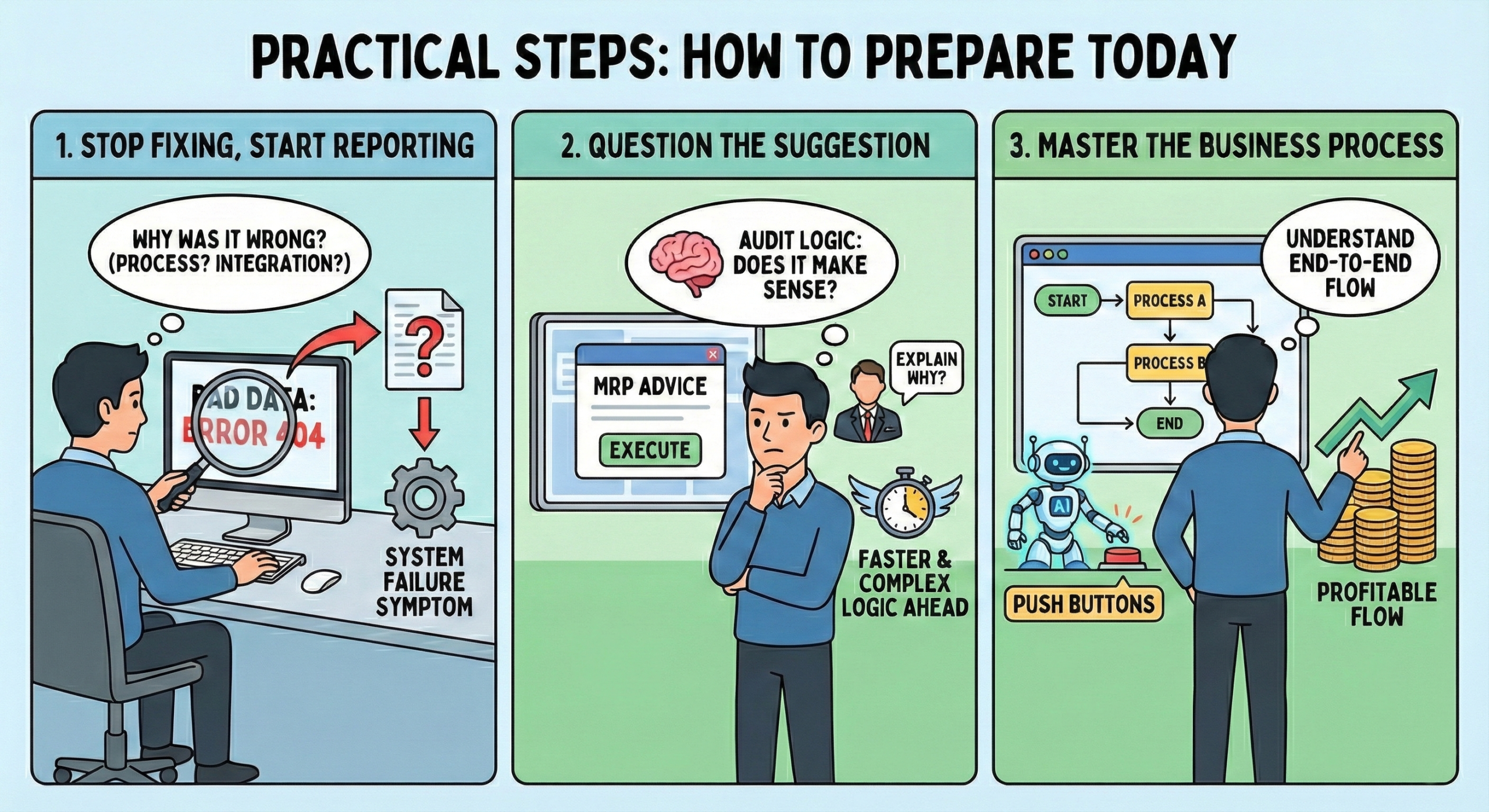
Practical Steps: How to Prepare Today
You don’t need to wait for the Agent to arrive to start practicing, but you can evolve your mindset starting today:
- Stop Fixing, start reporting: when you see bad data, don’t just silently fix it and move on.
Ask why it was wrong: was it a process error? A bad integration? Treat every data error as a symptom of a system failure. - Question the suggestion: when MRP gives you an advice, don’t just execute it.
Look at it. Does it make sense? If you had to explain why to the CEO, could you? Practice auditing the system’s logic now, so you are ready when the logic gets faster and more complex. - Master the Business Process, not just the session: stop memorizing buttons. Start understanding the end-to-end flow.
The AI can push the buttons, but only you can understand if the flow is profitable.
The Ultimate Upgrade
In my previous analysis, The Evolution of the ERP Consultant, we saw that moving away from writing custom 4GL code didn’t make technical consultants less valuable; it made them strategic partners who build robust architectures.
The same applies here for the Business User.
When you stop spending 4 hours a day copying data from Excel to Infor LN, or manually keying in orders, you aren’t losing your job: you are gaining 4 hours to do what humans do best: Negotiate, Strategize, Empathize, and Innovate.
The AI is the engine. Data is the fuel. You are, and always will be, the driver.
Written by Andrea Guaccio
January 14, 2026