

The Exception Paralysis: Why Your Team Freezes When AI Fails
(Part 3 of the series “The Human Downgrade”)
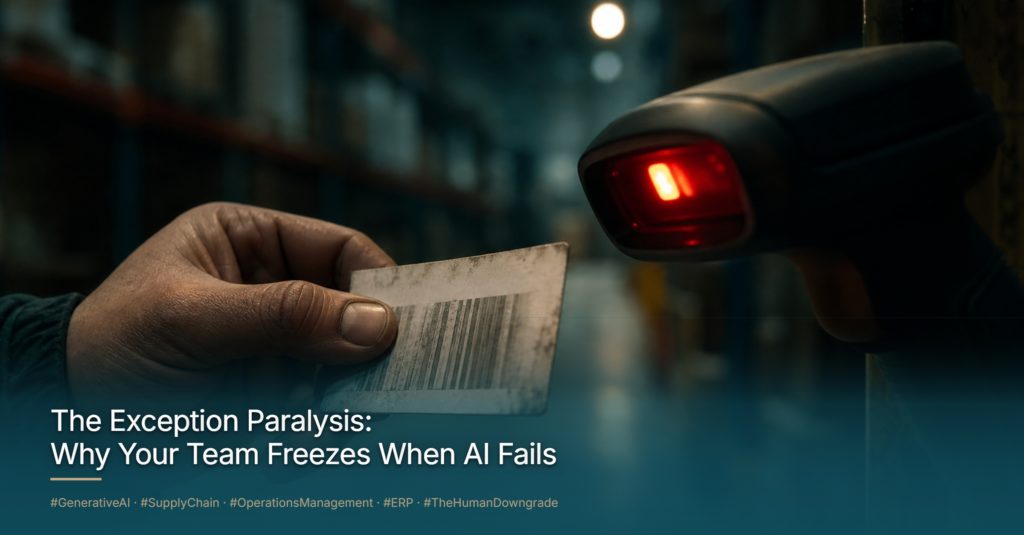
Some years ago, while working on-site at a client’s facility, I watched an entire software implementation team freeze in their tracks. They had just deployed a new Warehouse Management System (WMS), and almost immediately, a purely physical problem arose: the barcode labels for the storage bins were printed incorrectly and the scanners couldn’t read them.
The team that had implemented the WMS froze. They stood there, staring at their screens, waiting for someone to tell them what to do.
Normally, the first reaction to a physical problem is to walk onto the warehouse floor, grab a label, and test it on different scanners. You isolate the variable: is it the label itself, or is it a specific scanner setting? Once you find the root cause in the physical world, you fix it and move on.
But this team didn’t walk onto the floor. They stayed at their desks, frantically searching through the WMS manuals and digging into the software configurations, desperately trying to find a digital fix for a problem printed on paper.
Thinking about that moment today, a thought crossed my mind: what would this exact team do today, now that we have artificial intelligence everywhere?
I almost laughed out loud picturing it. They would probably take photos of the defective labels with their phones, upload them to ChatGPT, and sit there waiting for an algorithmic response while the warehouse manager threatened to lock them in the office until the problem was solved.
This memory highlights a growing crisis that extends far beyond enterprise consulting. My concern is that we’re raising a generation of professionals who are dependent on software to dictate their next move. So, when a system breaks, they lose the ability to improvise.
The Tyranny of the Happy Path
Artificial intelligence and advanced ERP systems are exceptional at managing the happy path. If the data is clean, the process is standard, and the physical world behaves exactly as expected, the automation is a miracle of efficiency.
But the physical world is a different beast. Machines break, suppliers miss delivery windows, barcode scanners fail, and inventory gets misplaced. Enterprise operations are defined by exceptions.
Before advanced automation took over every decision, handling these exceptions was the core skill of a plant manager or an operations consultant. You looked at a broken process, understood the underlying goal, and invented a temporary workaround to keep the business moving.
Today, as we delegate more and more of our daily logic to AI, I believe this muscle is atrophying.
When an anomaly occurs that the system wasn’t trained to handle, human operators will increasingly tend to panic. They will spend so long blindly following the optimal route generated by the software that they will no longer understand how to navigate without it. The system will become a crutch, and without it, they will fall.
The same atrophy is spreading through executive offices and consulting firms globally. We are gradually surrendering our capacity for quick, independent problem-solving.
The Illusion of Total Control
By definition, human nature drives us to seek absolute control over our environment, regardless of how chaotic the real world actually is. Anything outside our direct control naturally puts us under immense pressure. Because of this, we look at a perfectly designed dashboard fed by predictive algorithms and we feel the illusion of having finally achieved total control over the physical world.
This assumption is born from a lack of technological culture. The technology is evolving much faster than our human ability to study and comprehend it. Instead of digging into the mechanics and understanding what lies behind the marketing labels that define these systems as “intelligent”, we trust them blindly.
This creates a dangerous complacency. The team stops looking at the actual production line and starts managing the business entirely through the screen.
When the inevitable physical exception occurs, the gap between the digital representation and the physical reality becomes a trap. The AI continues to optimize for a reality that no longer exists. Meanwhile, the human team, stripped of their critical problem-solving skills, is unable to bridge that gap.
They sit paralyzed, waiting for an error prompt that will never arrive. They wait for the machine to give them permission to act, when it should be the exact opposite: the machine asking the human for permission. By waiting for the algorithm’s green light, they surrender their ability to react to chaos.
The Atrophy of System Knowledge
This phenomenon is alarming for system integrators and ERP consultants. In the past, if a customized workflow failed, the consultant had to roll up their sleeves, trace the data flow, and manually intervene in the system tables. They knew the architecture inside and out because they had built it with their own hands.
Now, we see consultants relying on AI assistants to write their scripts, configure their environments, and troubleshoot their errors. When the AI generates a configuration that works for the standard flow, the consultant deploys it without fully understanding the underlying mechanics.
The moment a complex exception breaks the logic, the consultant will be just as paralyzed as the warehouse worker. They will ask the AI to fix the bug, but the AI will lack the specific physical context of the client’s warehouse floor.
By delegating so much to AI today, we risk outsourcing our problem-solving skills and those uniquely human strengths that have historically defined our expertise. The consultant, having never learned the deeper mechanics of the software, will find themselves unable to manually debug the issue.
The result is a project that stalls for days over an issue that a seasoned professional would have resolved in an hour. By relying on AI to do the heavy lifting during the design phase, the consultant sacrifices their ability to intervene during an emergency.
The Context Illusion
Why will we be so unprepared for these exceptions? The core issue is how we are trained to use AI models. Most of us train nothing at all.
We often feed the wrong information to the model, or we fail to provide adequate context. We type a quick prompt and expect the algorithm, pulling from hundreds of different sources across multiple systems, to provide the exact answer for the specific software version we are using right now.
No professional would throw a complex problem onto the desk of a colleague on their first day and expect an immediate solution. Yet, we do exactly this with models that lack a properly designed, pre-loaded memory. Problem-solving in a warehouse or during a system failure requires immediate action. Only someone who has been actively working on the process up to that exact moment can truly understand the failure and begin to fix it.
An AI that isn’t deeply contextualized and prepared beforehand is ineffective once the damage is already done. When we rely on generalist tools without providing structured context, we leave our teams defenseless when the operational conditions inevitably degrade.
The Cognitive Cost of Convenience
It’s easy to blame the software vendors for overly rigid systems, but the truth is that we willingly accept this downgrade in exchange for convenience. Constantly evaluating alternative scenarios and maintaining a deep, structural understanding of an enterprise architecture is exhausting.
When an AI will offer to take that cognitive load off our shoulders, we’ll eagerly accept. We’ll let the machine generate the routes, write the code, and flag the anomalies. We’ll convince ourselves that this makes us more efficient.
Long story short: we save a few hours during the standard workday, but we pile up a dangerous debt of operational resilience. The moment a true crisis strikes, all the time we saved by not thinking is lost to the paralysis of not knowing what to do.
We’ll trade our capability to manage the unexpected for the comfort of an automated routine. In the high-stakes environment of enterprise consulting and supply chain management, comfort will become a liability. The value of a human expert will lie precisely in their ability to navigate the gray areas that algorithms cannot comprehend.
Reclaiming the Chaos
We can’t afford to let our teams lose their edge. Implementing AI should support us in analyzing data faster, and keep our problem-solving instincts intact.
If we want resilient supply chains and adaptable operations, we have to intentionally inject friction back into our training and daily routines. We need to train our consultants and operators on how to use the system and on how to bypass it when it fails.
When you implement a new automated flow, you must dedicate equal time to testing the breakdown scenarios. Force the team to run a shift with the system offline. Ask your consultants how they would manually calculate a replenishment order if the AI suddenly went blind.
Don’t let the algorithm become the only source of truth on the shop floor.
The true value of a professional emerges when the system crashes and the physical world reasserts its chaos. The next time a simple barcode refuses to scan, the algorithm won’t save the shift. The human ability to improvise will.
Written by Andrea Guaccio
August 27 2026