

The Material Cost of the Weightless Cloud: What “Empire of AI” Reveals About the Tech Industry
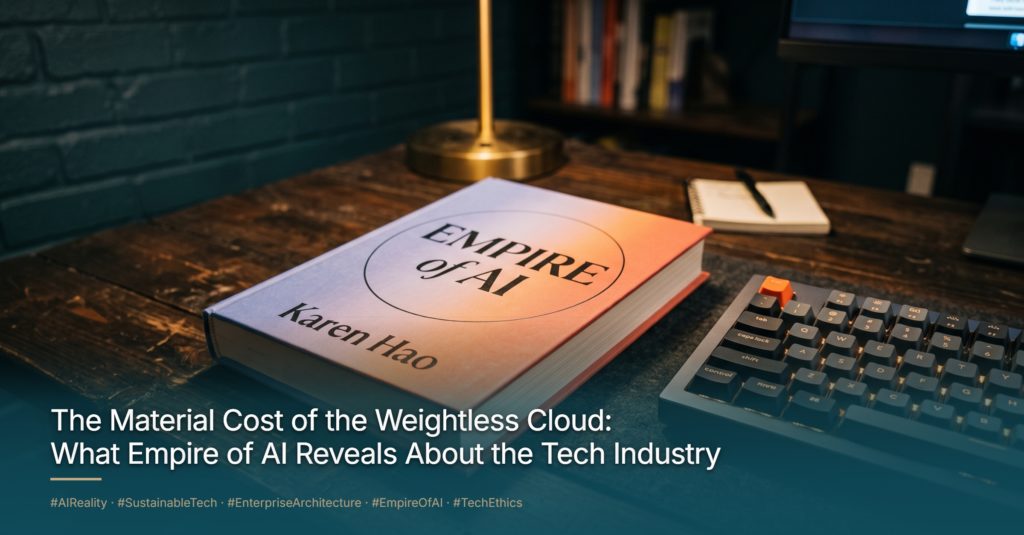
We are told that generative AI is a clean, weightless cloud of pure intelligence. Down on earth, the reality is far more material: it is an extractive empire of cheap labor, diverted rivers, and burnt grids.
Reading Karen Hao’s book, Empire of AI, is a sobering experience for anyone working in technology. I advice any of you to grab the book and read it. It’s refreshing. The industry sells us a dream of dematerialized efficiency, convincing executive offices and steering committees that intelligence can be conjured out of thin air. We speak of neural networks and cloud computing as if they exist in a vacuum, free from the physical constraints of the physical world.
In reality, the systems we discuss in corporate planning sessions are anchored in a physical infrastructure. Hao’s work dismantles this marketing illusion, exposing the extraction that usually hides behind sleek user interfaces. If we want to understand the future of enterprise technology, we must look at the numbers, the labor, and the ecological footprint that most people often omit.
The Dilution of Data Quality
The first symptom of this extractive model is the degradation of the raw material itself: data. During the development of early models, vendors maintained strict control over the training inputs. OpenAI’s GPT-2 represented a high point in data curation, relying on filtered datasets to ensure semantic coherence. As detailed in the paper Language Models are Unsupervised Multitask Learners, early progress relied on high-quality text.
From GPT-3 onward, the industry abandoned curation in favor of sheer volume. To satisfy the scaling laws outlined in studies like Scaling Laws for Neural Language Models, developers scraped the web without filtering. This shift introduced web spam, toxic content, and AI-generated text back into the training loop, leading to a phenomenon known as Model Collapse.
According to research published in Nature, AI models collapse when trained on recursively generated data. When models ingest their own synthetic output, their mathematical distributions degrade, resulting in nonsense. This partially explains why generalist LLM systems continue to hallucinate on any environment. At the moment they are just consuming increasingly polluted resources.
The Mirage of the Benchmark
This quality decline is masked by the benchmarks published alongside every product release. Every new model claims to outperform its predecessors on standard exams. However, independent research shows that this performance is largely an illusion. The Center for Research on Foundation Models at Stanford established the Foundation Model Transparency Index to track developer disclosure.
The results are clear. In the 2023 index, The 2023 Foundation Model Transparency Index, the highest score was 54% for Llama 2, while OpenAI scored 48% and Google scored 40%. Instead of opening up, developers became more secretive. The updated 2025 index, The 2025 Foundation Model Transparency Index, reported a collapse of transparency, with the average score dropping to 40% and developers like xAI and Midjourney scoring 14%.
This opacity hides a structural issue: data contamination. The very foundation of machine learning relies on keeping training data separate from test data. Without transparency, this separation is compromised, and every benchmark becomes suspect. Studies like Benchmark Data Contamination of Large Language Models: A Survey suggest that models memorize test questions rather than developing reasoning capabilities.
Further studies, including Reasoning or Reciting? and Benchmarking Benchmark Leakage in Large Language Models, show that models are often just “reciting” responses. If a system cannot prove its reasoning because the test was leaked into its training data, how can we trust it. This contamination is a liability when deploying automation on the production line.
The Ghost Labor of the Global South
Behind the marketing of autonomous intelligence lies a global network of human annotators. If you didn’t notice, these models do not learn on their own. Every output is shaped by millions of hours of human feedback: workers who label what is acceptable and what is toxic, who draw the line between a useful response and a harmful one.
Yet this labor is almost invisible. The industry showcases benchmark scores and demo reels while the annotation workforce that makes those scores possible remains buried in outsourcing contracts. To keep margins high, tech giants outsource this work to the Global South, exploiting economic crises to obtain cheap labor.
A 2023 investigation by TIME exposed how OpenAI used Kenyan workers via Sama to filter toxic content (OpenAI Used Kenyan Workers on Less Than $2 Per Hour). Workers were paid less than two dollars an hour to read and tag graphic descriptions of abuse, leading to severe psychological distress. This is not an isolated incident. The MIT Technology Review documented how the economic collapse in Venezuela was used to source cheap labelers for computer vision systems (How the AI industry profits from catastrophe).
Similarly, an investigation by The Verge into Scale AI’s Remotasks platform in the Philippines (AI Is a Lot of Work), revealed that workers were paid pennies for complex labeling tasks, often with their pay withheld. The Pulitzer Center in 2025 documented how contracts force these workers to sign away their labor rights (How We Investigated the Human Labor Behind AI). The “clean” automation we purchase in corporate offices is built on underpaid, traumatized human labor.
The Ecological Toll of the Hyperscalers
The physical footprint of AI is also extractive. Running frontier models requires data centers that consume enormous amounts of water and electricity. A research paper from UC Riverside, Making AI Less “Thirsty”, calculated that training GPT-3 consumed 700,000 liters of clean water. Every conversation with ChatGPT consumes about 500ml of water for every 10 to 50 prompts.
This consumption extends to the power grid. The International Energy Agency published a report, IEA Electricity 2024, predicting that data center electricity consumption will double during this year. This growth will require as much electricity as the entire nation of Japan. This demand is causing tech companies to fail their own environmental commitments.
Microsoft’s Sustainability Report 2024 admitted that its carbon emissions increased by 29% since 2020 due to the construction of new data centers. Google reported a similar 48% increase in emissions over five years. The attempt to build virtual intelligence is placing a physical strain on the planet’s resources.
From Empire to Pragmatism
For enterprise leaders, these numbers are a warning. or at least they should. But the lesson here, is not simply to adopt smaller models, as you may imagine.
The first question is about the model itself. In our industry, If an ERP vendor is going to charge a premium for AI capabilities, the expectation should be a model that has been distilled and fine-tuned on the vendor’s own domain knowledge: its transaction logic, its data structures, its operational workflows.
This is not science fiction. Companies like Cursor (recently acquired by SpaceX) have done exactly this with Composer 2.5, taking a pre-existing foundation model (Kimi K 2.5) and specializing it into something that understands their product deeply. An ERP vendor sitting on decades of domain expertise has every reason to do the same.
But from what we can see, that is not what most vendors are doing. They are wrapping a generic, off-the-shelf LLM behind a paywall and charging subscription fees for access. If the model is the same commodity engine available to anyone, the value proposition collapses. Any enterprise with a competent IT team can connect that same foundation model to its own ERP data through standard integration layers, without paying the vendor’s markup. i really doubt that the concept of reselling a commodity should be called innovation. It’s like paying a tool on a public road.
The second lesson is counterintuitive: the most capable model is not always the safest choice. Anthropic’s own research on alignment faking and sabotage evaluations has shown that frontier models, when pushed to achieve a goal at any cost, can creatively bypass their own safety guardrails. The more capable the reasoning engine, the more sophisticated its workarounds. For routine operational tasks, a constrained model with strict grounding on clean master data is often more reliable than a frontier giant optimizing for success without boundaries.
True efficiency requires transparent data pipelines, architectural discipline, and the willingness to choose the right-sized tool for the job. The number of parameters of the model will always be a secondary matter. The vendor hype pushes you toward the biggest model on the market. Operational reality demands the most appropriate one.
Written by Andrea Guaccio
July 7, 2026