

Keeping Your Data Behind the Firewall: Local LLMs and Read Replica Strategy
Another week, another simulation. This time, picture an AI agent that was tasked with analyzing inventory. It ran an unoptimized search loop on the live database, locking tables and halting the shipping bay for two hours.
Connecting probabilistic models to your production systems looks nice to me only on a slide. Overall, it’s a gamble you won’t be able to afford.
This is the fifth episode of Pragmatic AI for Operations, a series designed to bring architectural discipline to generative AI projects on the factory floor.
Black Box Risk
If by now you still don’t know, Generative AI remains a black box. The same labs that build these neural networks are still studying how they behave, after commercialization.
Because these models are probabilistic, they don’t follow standard database validation logic.
If you hook a third-party cloud API or an autonomous agent to your primary transactional database, you expose your business to two immediate threats: performance crash and a data sovereignty breach.
An agent running a complex investigation loop might query the database thousands of times in a few minutes. You think any ERP Vendor will be watching passively? Querying the database always brings cost. And if you’re on the cloud, the vendor is paying it and will invoice you the delta.
An agent doesn’t check if the network is busy or if CPU utilization is spiking. It requests data until it’s finished, locking transactional tables and freezing the software that runs your daily operations.
At the same time, sending proprietary operational data to external endpoints introduces significant risk. Your production volumes, supplier prices, and warehouse layout are competitive assets.
They don’t belong in a vendor’s training set.
To implement AI safely, we must establish a solid architecture.
First Wall: The Read Replica Strategy
The first layer of isolation relies on separating transactional writes from query reads. We achieve this by deploying a read replica. You may have noticed I referenced this concept earlier in the series. This is the moment to explain exactly what it means.
A read replica is an exact copy of your primary database that is synchronized (asynchronously) in real-time.
Your primary database is the engine of record, no? It handles transactional writes: validating stock movements in the WMS, posting ledger entries in the ERP, and processing assembly logs. It must remain deterministic, fast, and most of all, protected.
The read replica handles the heavy lifting of reading and querying. Not every table needs to be exposed to the agent.
In practice, you start with 10%, maybe 20% of your data, focusing on the workflows that matter most. A full ERP replica on day one is not a realistic starting point for most organizations, and it doesn’t need to be.
Start small, and build from that.
When you configure your AI agent or retrieve context for Vector RAG we discussed previously, you direct all database queries to the read replica.
If the agent gets stuck in a loop, issues slow SQL queries, or crashes, the primary database is unaffected. Barcode scanners continue processing receipts, shipping labels continue printing, and the trucks keep loading.
You decouple the probabilistic search from the deterministic transactions. Your core systems stay responsive.
If you are on the cloud, you also protect your compute rate limits from agent-driven spikes.
Second Wall: Local Open-Weight Models
Directing database traffic to a replica protects your performance, but it doesn’t protect your data. To secure your information, I would evaluate running your language models locally.
Until some months back, using generative AI meant sending data to cloud APIs.
Today, the performance of local models has changed drastically the equation. Open-weight models can be deployed on private servers inside your corporate network.
For operational tasks, you don’t need the largest, most expensive cloud engines.
A model focused on parsing shipping documents, extracting part numbers, or matching emails requires structural reasoning, not general knowledge. A small, optimized model running behind your firewall delivers high accuracy at a fraction of the cost.
Because the model runs locally, your operational data never leaves your infrastructure.
You maintain absolute data sovereignty while eliminating the variable usage costs and latency of cloud API calls.
As always: start small. You can always begin with a cloud model to validate the workflow. Once the approach is confirmed, migrate the same logic to a local deployment.
Isolation in Action: A Shop Floor Scenario
To see how these layers work together, let’s walk onto the shop floor.
A maintenance planner wants to identify the root cause of an assembly line bottleneck. They ask an AI agent to analyze historical machine log data from the last three years, which involves reading maintenance tickets and sensor alerts.
The Direct Approach
Without isolation, the agent queries the primary MES database.
The heavy database query causes CPU utilization to spike. The main terminal freezes. Operators on the production line cannot log completed assemblies, and supervisors cannot release work orders. If you work on the Cloud, you hit your compute limits faster than ever, without even completing the task. A complete waste of resources.
The Hardware limits stops your workflows while the AI is still thinking.
The Protected Approach
With our isolation pattern, the agent connects to the MES read replica.
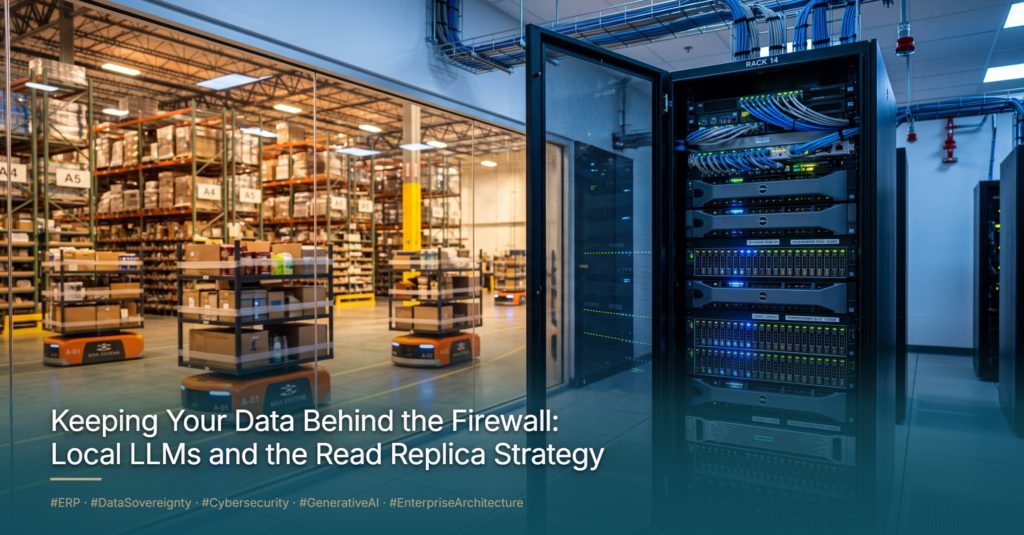
It retrieves the historical logs and processes the text using a local model running on a private server rack in the IT room.
The query runs, the analysis completes taking the time it requires, and the agent compiles the bottleneck report.
Meanwhile, operators on the line continue logging assemblies without experiencing a single millisecond of latency. The database remains fast, and the data never leaves the building.
Fencing the Playground
Integrating AI is not about letting the model run free across your systems. I was skeptical months ago. I am more skeptical now. LLMs in production environments are still proving faulty.
It’s all about building fences.
By combining a read replica with a local model, you create a secure playground. You also give your business the time to learn, make mistakes, and refine.
A luxury you won’t have if your token consumption is driving a monthly cloud invoice you can’t control.
The probabilistic model can execute complex queries, but it cannot slow down operations because it is decoupled from the transactional engine. The model can process sensitive inventory files, but it cannot leak them because it runs behind your private firewall.
You get all the reasoning power of generative AI with none of the operational risk.
In our final episode, we will bring all these components together: agents, read replicas, MCP servers, and structured knowledge graphs, to map the complete composable blueprint for enterprise AI.
Written by Andrea Guaccio
July 23, 2026