

Software Fatigue: A Pragmatic Guideline to Filter the GenAI Noise Around Your Core ERP
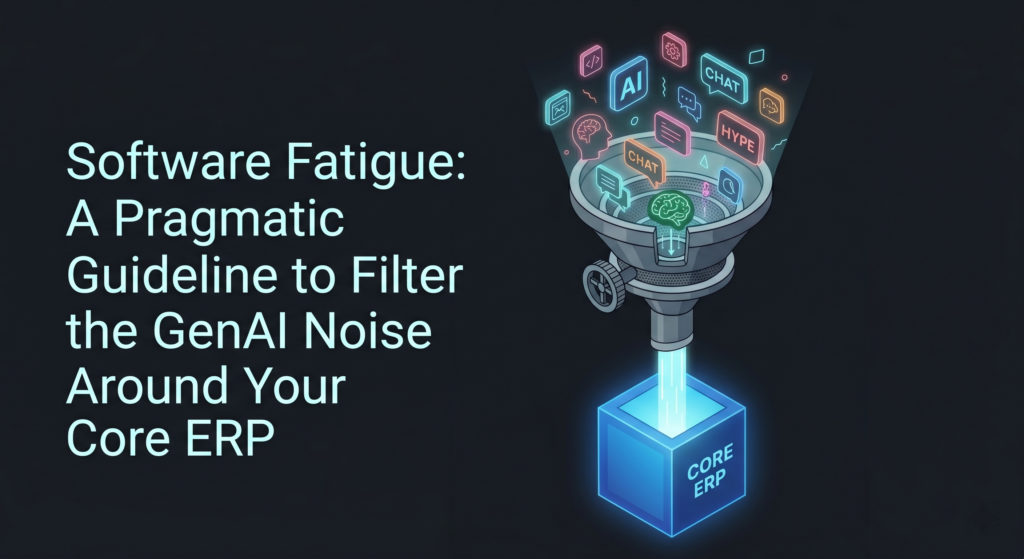
Open your inbox. Scroll through LinkedIn. Sit through a single vendor meeting. The promise is always the same: artificial intelligence is here to autonomously optimize your entire supply chain.
Believe me I know, It’s exhausting.
The software fatigue is real. Every day brings another wave of the 200,000 new GenAI applications launched weekly, each claiming to make your business run better with just a new subscription or a license upgrade.
The tragedy of this hype cycle is not the bad software. The real tragedy is that decision-makers, completely overwhelmed by the noise, are shutting the door entirely. In doing so, they are locking out the rare 10% of AI applications that actually deliver game-changing value on the factory.
To find that 10%, you need a heavy-duty filter, not a bunker. You need a pragmatic system that de-risks adoption while protecting the systems that actually run your business.
Start at the Bottleneck, Not the Slide Deck
Forget the grand promises of total business transformation pitched in high-level meetings. When vendors sell you an all-encompassing AI solution that supposedly touches every node of your enterprise, they are selling you a project management headache.
True pragmatism starts at the bottom, not the top. It favors highly specific, localized AI deployments designed to solve a single, frustrating bottleneck.
Think about your warehouse receipt process. Every day, different suppliers send packing slips, bills of lading, and delivery notes in completely unique layouts. Your team probably spends hours manually reading and typing this data into the system, creating a persistent data entry delay.
Implementing a localized, specialized AI tool just to parse these non-standard documents and match them against your purchase orders is a pragmatic victory. It takes few weeks to deploy, has a clear ROI, and solves a real pain point without disrupting a single core process.
Don’t buy a generic AI suite. Buy a narrow solution for a narrow problem. Once that single node works, move to the next.
Build Composable, Not Custom
Don’t try (Yes, I know you’re doing it already) to force your core ERP to do things it was never meant to do. In the rush to adopt GenAI, many IT departments are making the classic mistake of seeking deep, custom integrations that bake unverified, fast-evolving AI logic directly into their core databases.
This will guide you to a long-term disaster. Your core ERP is the system of record. It is built for transactional integrity, financial compliance, strict security perimeters, and predictable, continuous updates.
If you customize the core engine with volatile, experimental AI code, you freeze your system. You make future upgrades extremely costly and introduce huge operational risks.
The solution is to build a composable ecosystem. Keep your core ERP as standard as possible and most of all, clean. Connect specialized, best-of-breed AI applications through APIs.
Using robust integration platforms like Infor OS or similar API gateways, you establish a clean separation of concerns. The API layer acts as a translator and a safety buffer, ensuring that your ERP is never compromised by an external application’s execution error.
This architectural separation contains your risks. If a specialized AI application for inventory forecasting experiences model drift, hallucinates, or goes out of business, the impact is isolated. You simply unplug the API and swap the brick for another one.
Safe adoption is not about avoiding innovation. It’s about containing the blast radius when innovation goes wrong.
The Deterministic Line Your AI Cannot Cross
Don’t let the marketing hype dictate your technical architecture. Enterprise software is quite different from a sandbox for testing viral trends. It’s the operational backbone of anyone’s company, and its design must remain focused on compliance, continuous security updates, and predictable transaction logic.
The fundamental conflict in enterprise tech today is the collision between deterministic and probabilistic tools.
Your supply chain, warehousing, and financial ledgers must be deterministic. When you transfer ten pallets from the loading dock to the warehouse racking, the system must reflect exactly ten pallets. There is no room for approximation.
Don’t confuse an ERP with an automated chat window. Every single transaction inside that database carries direct financial and operational consequences. If a language model misinterprets an inventory code or a quantity field during a bulk update, it corrupts your Data and halts your entire shipping line.
GenAI models are probabilistic by design. They are built on statistical weights, guessing the next best word or predicting the next transaction. While they excel at summarization and pattern recognition, they are naturally prone to hallucinations and drift.
Injecting a probabilistic engine directly into a deterministic inventory flow is an architectural mistake. Filter the noise by drawing a clear boundary. Let the traditional, deterministic code run your core transaction cycles, and use AI exclusively outside that boundary to analyze, suggest, and flag anomalies, at least in these moments where the technology is evolving at a pace no one can surely predict.
Give Them Your Worst Data
The final and most effective way to filter out the noise is to force a ruthless field test. When a vendor presents a pristine slide deck and a controlled database demo where everything works like a Swiss watch, do not just nod and smile.
Challenge them. Step out of the sterile laboratory environment and invite them to run a demo in an unprotected, real-world scenario using your actual operational data.
For Example, if you are evaluating a tool for faster receptions, give them your real, everyday barcodes. Not the clean, digital vectors from their slides. The physical ones: wrinkled, dirty, and torn shipping labels that have traveled across three continents in a damp cargo container.
Give them your real, chaotic document scans where labels are misplaced, text is faded, and layouts are non-standard.
This is the ultimate test. It is easy for an OCR or document parsing AI to recognize everything in a millisecond when every label is placed perfectly and every letter is readable. The true value is proven when the system can reconstruct incomplete data, handle physical imperfections, and operate under pressure.
If the software only works under laboratory conditions, it will fail on your warehouse floor. It will fail on a noisy Friday afternoon at 4:30 PM, when a tired logistics operator is rushing to load the last truck of the week and has zero time to fight against rigid, fragile systems that demand perfect inputs to execute what for him it’s a simple transaction.
Where the Filter Ends and the People Begin
True digital transformation does not happen behind closed doors while reviewing sterile slides. And it is certainly not achieved by purchasing hundreds of speculative software licenses.
It is achieved when you clean your data, standardize your interfaces, and build a composable architecture that can absorb change without breaking.
Most importantly, it is achieved when the technology respects the people getting their hands dirty every day to keep your company running. So protect your core, contain the blast radius, and let the messy reality of your factory be the final judge of what works and what doesn’t.
Written by Andrea Guaccio
June 9, 2026