

Garbage In, Disaster Out – The Governance of Cleansing
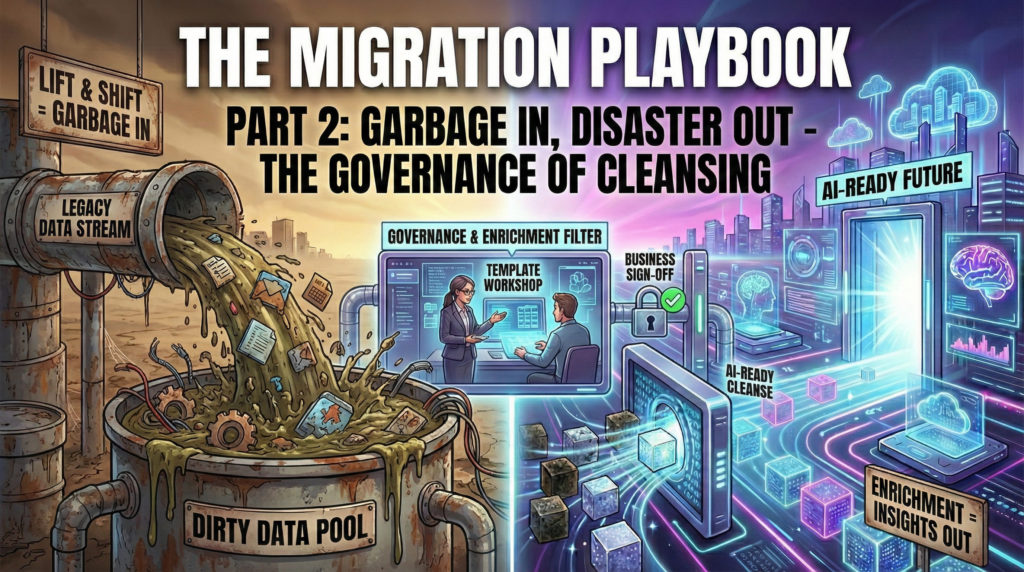
(Part 2 of series “The Migration Playbook”)
In Part 1, we made the strategic decision to perform a Clean Cut leaving the dead weight of history behind to build a lean, modern ERP. We decided to stop looking in the rearview mirror and start looking at the road ahead.
Now, we face the reality of that decision. We have defined what to move (Open Orders, Active Items), but we haven’t discussed how to move it without contaminating the new environment.
In all these years I learned a harsh truth that I repeat like a mantra: Data Migration is not a specific IT task.
If you assign data cleansing to your IT department, your project is already dead. The IT team knows how to move bits from Column A to Column B using scripts. But IT does not know that Customer 1001 went bankrupt last week, or that the supplier for Item X has changed from Italy to Vietnam, requiring a completely different Tax Code and Lead Time.
This article is about the Governance of Cleansing. It is about transforming the migration phase from a technical burden into a strategic opportunity for Data Enrichment and User Education.
The Mindset Shift: From Cleaning to Enrichment
The traditional approach to migration is what we call Lift and Shift: take the legacy data, scrub it slightly (remove obvious duplicates), and force it into the new system. This is a wasted opportunity of massive proportions.
Your new Cloudsuite ERP is a Ferrari compared to the legacy system you are likely migrating from. It has fields, logic, and dimensions that your old system never had. If you treat the migration as a simple copy-paste exercise, you are essentially putting a Fiat 500 engine inside a Ferrari chassis.
Enrich, Don’t Just Copy
If you simply map Legacy_Name to NewERP_Name, you are crippling the new system. The migration phase is the only time in the next 10 years where you will have the budget, the focus, and the executive mandate to Enrich your Master Data.
Here is the difference between Cleaning and Enrichment:
- Cleaning: Removing duplicate customers and fixing typos in addresses. This is the bare minimum.
- Enrichment: Using the migration to populate new fields that drive modern business logic.
Take Infor LN as an example. Your legacy system might treat a supplier simply as a Name and Address. Infor LN treats that supplier as a complex entity with a Financial Business Partner, a Ship-from, a Ship-to, and a Pay-to role. It asks for Signal Codes (credit warnings) and Payment Terms that trigger automated workflows.
This is your opportunity. Don’t just copy the address. Use this moment to categorize your items for better future analysis. Redefine your Item Groups to match your current reporting needs, not the needs you had in 2005.
The Template as a Teaching Tool
This is the most underrated aspect of any ERP project and a secret weapon for successful Change Management.
Most consultants treat the Migration Template (usually a complex Excel file) as a technical necessity.
They email it to the user saying: Fill this out by this Due Date.
This is a disaster waiting to happen.
The user opens the file, sees 50 columns with names like tccom100.nama or tcibd001.citg, panics, and fills it with garbage just to make the validation errors go away. They see the template as a bureaucratic form to be stamped and forgotten.
The Human Bond Methodology
Over the course of my experience, the Template Workshop more like a ritual. The consultant sit down with the Warehouse Manager, the Buyer, or the Chief Accountant, and we go through the template column by column.
We transform this session from simple data entry into a Training opportunity.
When the Warehouse Manager asks: Andrea, why is there a column for ‘Location Type’? We just put pallets wherever there is space.
That is my moment to explain: If we define ‘Bulk’ versus ‘Pick’ locations now, Infor LN can generate replenishment missions for your forklift drivers before the picking face runs empty.
The Strategic Result:
- Early Education: the user learns the terminology of Infor LN before they ever see a screen. They understand the data model intellectually before they navigate it visually.
- Collaboration: the user realizes I am not here to impose a system, but to translate their business reality into the new engine. This builds the Human Bond, the trust that will save the project during the stressful days of Go-Live.
- Ownership: because they understood why the field matters, they care about what they type into it. They stop treating the cell as a bucket and start treating it as a decision.
The Business Signature Rule
Who signs off on the data? In many failed projects, both the internal IT and the vendor’s (or partner’s) technical team run the script, see “0 Errors,” and declare victory. Then, on Day 1, the invoices are sent to the wrong addresses, and the truck drivers are stuck at the gate.
There is a golden rule in this racket: the Business owns the Data.
I enforce a strict governance protocol that scares many users at first, but protects everyone in the end:
- Extraction: technicals extracts legacy data into the Staging Template.
- Enrichment: the Key User (e.g., Sales Manager) reviews, cleans, and adds missing info.
- The Signature: the Key User must validate the data and confirm we can move on onto the next step.
If they don’t confirm, we don’t load.
This shifts the psychological burden.
The user stops thinking, the system is wrong and starts thinking I need to make sure my data is right.
The AI Imperative: Why “Good Enough” is Dead
In 2015, if you had a few duplicate customers or some items with missing weights, it was annoying. In 2026, it is fatal.
We are moving into the era of Agentic AI and Infor GenAI. These tools interpret patterns and semantic meaning.
- The Scenario: you ask Infor GenAI, Predict my stockout risk for next month.
- The Dirty Data Reality: you have migrated old lead times from 2019 that are no longer valid, or you have duplicate item codes where one has stock and the other doesn’t.
- The Outcome: the AI sees conflicting patterns. It tells you to buy stock you don’t need, or worse, tells you are safe when you are about to run out.
Garbage In, Disaster Out is no longer a metaphor. If your data isn’t clean, your expensive AI investment is worthless. The migration is your great filter. If a record isn’t clean enough to be mapped into the template, it doesn’t deserve to be in your AI-Ready future. Leave it behind.
According to Gartner, poor data quality is the primary reason for 40% of all failed business initiatives. In the age of AI, this impact is amplified because models magnify existing biases and errors in the dataset.
Source: Gartner – Data Quality Solutions
The Foundation is Set
We have the Strategy (Clean Cut). We have the Clean Data (Enriched and Signed-off).
Now, we need to move the bits and bytes. But be warned: having a clean Excel file is not the same as having data in the system.
In the next part, we leave the meeting room and enter the Engine Room. We will talk about Migration Tools, the DAL specifically, and how to handle the inevitable “False Positives” that terrify the uninitiated.
Written by Andrea Guaccio
March 18, 2025