

The Cognitive Factory – AI, ESG & The Future of MES
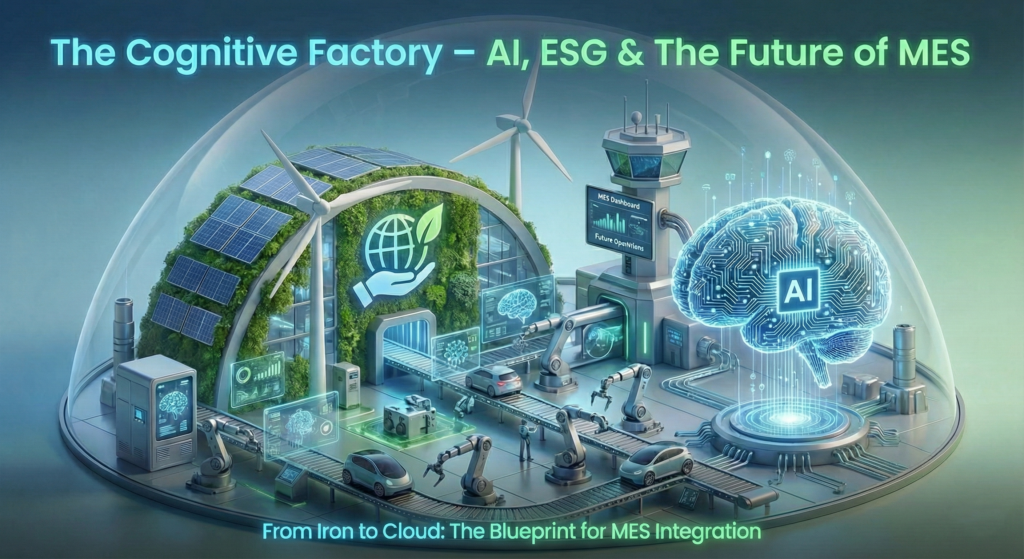
(The Finale of the series: “From Iron to Cloud: The Blueprint for MES Integration”)
We have defined the strategy (ERP vs. MES). We have tied the Gordian Knot of data synchronization. We have translated the voltage of the machines into digital signals.
If you have followed Parts 1 through 3, you now possess the blueprint for a Connected Factory.
You understand how Infor LN should detect when a machine starts, and how to free your operators from paper. That knowledge is the foundation.
But in 2025, being “connected” is just the baseline. It is table stakes.
The market is shifting under our feet. As noted in the 2025 Gartner® Market Guide for MES, vendors are aggressively pivoting from traditional perpetual licensing to Subscription and SaaS models. This shift represents a forced march toward modernization. Companies can no longer sit on a 15-year-old on-premise legacy system and expect it to work. You are being pushed into the cloud era whether you like it or not.
So, since we have to move, let’s not just rebuild what we had yesterday. Let’s build what we need tomorrow.
Welcome to the Cognitive Factory.
From “What Happened?” to “What Do We Do Now?”
Traditional MES systems are historians. They are fantastic at telling you that yesterday, Shift B produced 15% less scrap than Shift A. That is useful, but it is post-mortem data.
The MES of the future, which we are architecting today, moves from Descriptive Analytics (“What happened?”) to Prescriptive AI (“How do we fix it right now?”).
Here are the four trends that are turning the MES from a passive recorder into a proactive partner.
Trend 1: Generative AI & The “Agentic” Workflow
This is the biggest game-changer. Until recently, if a Plant Manager wanted to know why OEE dropped, they had to ask an IT guy to write a SQL query or build a PowerBI report.
With Generative AI (like Infor GenAI) embedded in the Infor OS platform, the interface becomes conversational.
The Scenario: Instead of clicking through ten menus, the Production Manager simply types (or speaks) into the system:
“Show me the top three reasons Line B stopped this week, and suggest a maintenance slot based on current orders.”
The Result: The system queries the Data Lake (Data Fabric), correlates the downtime codes from the MES with the production plan in Infor LN, and replies:
- Major cause: Overheating on Axis Z.
- Trend: Happening every 400 cycles.
- Recommendation: Schedule maintenance Tuesday at 14:00 (Gap in schedule found).
This is an Agentic Workflow. The system acts as an agent, analyzing and suggesting, not just displaying rows of data.
Trend 2: Green MES & Transition 5.0
Sustainability is no longer just a slide in the marketing deck; it is becoming a transaction in the ERP. In the era of Industry 5.0, Energy is a component of the Bill of Materials (BOM).
The Problem: The “Overhead” Trap
Traditionally, energy is treated like a “tax”, a fixed overhead buried in the machine hourly rate (Operation Rate / tirou).
- The Old Way: If your machine rate is €100/hour, Infor LN charges €100 for every hour of production, regardless of whether the machine is idling (low energy) or running at max power (high energy).
- The Consequence: You get “Cross-Subsidization.” Your low-energy products are artificially expensive (paying for energy they didn’t use), and your high-energy products are artificially profitable (subsidized by the others). You are flying blind on margins.
A Solution Example: The “Dynamic Injection” Pattern
To fix this, we stop treating energy as a fixed average and start treating it as a Direct Material.
However, adding an energy item to thousands of static BOMs (tibom) would be a maintenance nightmare. Instead, we use a Dynamic/Unplanned approach:
- In Infor LN, we define a generic Cost Item (e.g., ENER-KWH) with a standard price in ticpr. Crucially, we do NOT add this to the Bill of Materials. We keep the engineering data clean.
- The machine runs. The IoT sensors measure exactly 500 kWh consumed for that specific Production Order.
- Upon completion, the MES sends a transaction to Infor LN. It doesn’t just confirm the quantity produced; it injects an “Unplanned Material Issue” (Backflush) for 500 units of ENER-KWH.
The Outcome:
- Infor LN register the extra material, calculates the cost (Qty 500 * Price 0.22), and updates the Actual Cost of that specific order.
- You eliminate cross-subsidization. You might discover that a product you thought was profitable is actually bleeding money due to its high energy intensity.
This transforms energy from a fixed “tax” into a variable cost you can manage surgically.
Trend 3: Democratization (Low-Code/No-Code)
The bottleneck of digital transformation is often the IT department. If a department head wants to change a color on a screen or add a mandatory field for Quality Check, they wait for a developer.
We are empowering Citizen Developers, those tech-savvy shift leaders or process engineers, to build their own apps that connect seamlessly to Infor LN via APIs (ION/REST).
The Toolbox for the Modern Factory:
- Microsoft Power Apps: The de-facto standard. If you have Office 365, you already have it. It’s perfect for building simple mobile forms (e.g., “Shift Handover” or “Scrap Declaration”) that anyone can use on their phone.
- Node-RED: The “Swiss Army Knife” for IoT. It uses a visual, flow-based interface to wire hardware devices to APIs. Ideally suited for the Edge, it allows you to create logic like “If Temperature > 80°C, trigger Maintenance Order” without writing a single line of C# or Java.
- Infor Mongoose: For those who want to stay strictly within the Infor stack, Mongoose offers deep, native integration, allowing you to build complex screens that live directly inside the Infor OS workspace.
IT governs the security and the API access, but Operations owns the agility.
Trend 4: Hyper-Connectivity & Edge Computing
We talked about the Cloud, but sometimes the Cloud is too far away. If a robotic arm detects a human safety breach, it cannot wait to ask the Cloud server “Should I stop?”
It must stop now.
The Gartner Insight: The 2025 Gartner® Market Guide explicitly highlights that Edge architectures are emerging specifically to address cloud connectivity and latency concerns.
The Architecture:
- The Edge: critical decisions (Safety, High-speed Quality Sorting) happen on the Edge Gateway directly on the shop floor.
- The Cloud: the aggregated data is sent to the Cloud for long-term trend analysis and model training.
We are moving to a hybrid model where the MES has a “local brain” (Edge) that keeps running even if the internet goes down, ensuring business continuity.
The Autonomous Factory
In my opinion, the factory of the future is not empty of people. It is empty of wasteful human effort.
We are moving away from operators carrying clipboards and spending 20% of their shift entering data. We are moving toward a world where the MES and ERP run the standard process autonomously, and the human is only called upon to handle the exceptions.
- Don’t tell me the machine is running. I assume it is.
- Tell me when it will break in 4 hours so I can fix it now.
This concludes the 4-part series “From Iron to Cloud.”
Written by Andrea Guaccio
February 18 2026