

Pragmatic AI for Operations: A 6-Episode Roadmap to Implement GenAI Without Breaking Your ERP
Every month, a new vendor pitches the same promise: plug an AI agent into your ERP, and watch your entire supply chain optimize itself overnight. Every month, a different executive asks the same question: should we buy this?
My honest answer is that most companies still have no clear idea of how to implement AI effectively within their own operational flows. The gap is not in the technology available, that as for now runs faster it has been difficult to keep up with. The gap relies in understanding where exactly these tools belong inside the enterprise architecture.
The volume of noise around Generative AI in operations has reached a point where decision-makers are either paralyzed by the hype or rushing into poorly designed integrations. Between high-level steering committee decks and isolated sandbox demonstrations, there is a widening gap between what is being sold and what can safely be deployed in a production environment.
This article is the introduction to Pragmatic AI for Operations, a new 6-episode series I designed with the aim to close that gap.
Over the next six episodes, we will step away from pptx presentations and walk onto the physical workplace. We will explain these technical concepts clearly, show where they connect to the systems that run your operations every day, and demonstrate how to implement them without compromising your core transactional data.
Why This Series
The GenAI landscape is evolving fast, and some models are starting to prove their value (spoiler, is not the frontier ones). The technology is maturing, and clear entry points for enterprise adoption are beginning to emerge.
The problem is confusion over the architectural side.
Companies are injecting probabilistic tools into deterministic processes. They build fragile, custom integrations when standardized connections exist. They send sensitive operational data to cloud APIs without a clear sovereignty strategy.
None of these are theoretical risks. They are patterns that I and many fellow consultants see repeated across manufacturing, logistics, and supply chain environments, driven by a constant fear of falling behind and a reflex to act before stopping to think. Each episode of this series addresses one of these architectural decisions, explaining the concept, showing a concrete operational scenario, and presenting the design pattern that keeps your core systems safe.
A 6-Episode Roadmap
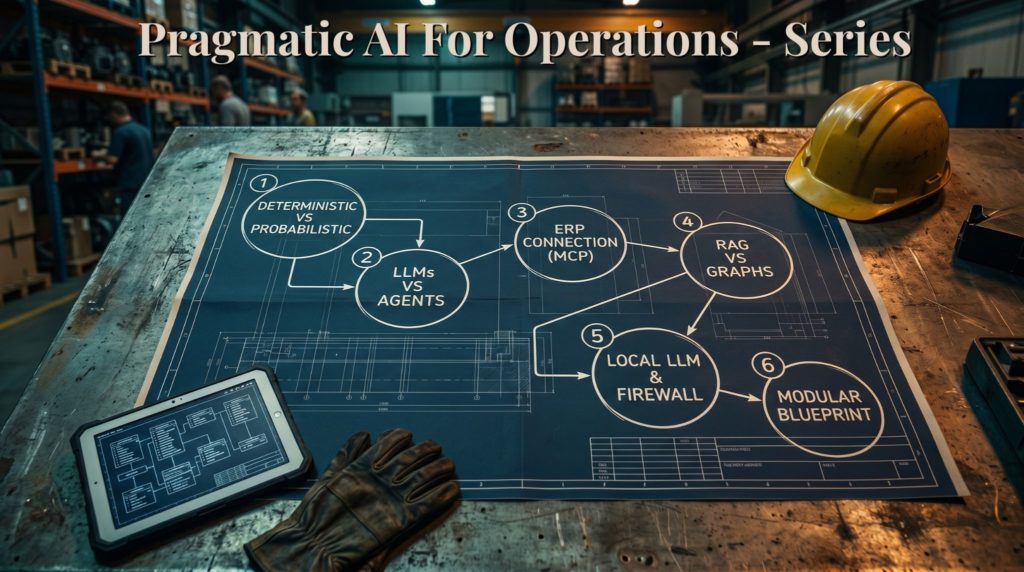
Here is the full roadmap. Each episode builds on the previous one, gradually assembling a complete, modular architecture for enterprise AI integration.
Episode 1: Deterministic vs. Probabilistic: Does Your Process Actually Need GenAI?
Starting from the very beginning. We define the boundary between rules-based systems and statistical models. Your ERP inventory ledger demands mathematical precision. On the other hand, your incoming supplier documents are messy and unstructured. Understanding which paradigm fits which process is the single most important architectural decision you will make.
Episode 2: LLM vs. Agent: The Shift from Prompts to Goals
A language model is a reasoning engine that waits for a human to type a prompt. An autonomous agent uses that same engine as its brain, but adds memory, planning loops, and the ability to use tools. Instead of waiting for input, an agent receives a high-level goal, breaks it down into steps, queries your systems, and executes the task autonomously. Understanding this distinction determines whether your AI is a tool your team controls, or a runaway process nobody in your company can audit.
Episode 3: How AI Talks to Your ERP
Integrating AI with enterprise databases has historically required building and maintaining custom connectors for every system. The Model Context Protocol changes this completely. Think of it as a universal port for AI. One standardized connection allows an agent to read your ERP tables, search local documentation, and query external tools securely. We will show how this protocol gives autonomous agents standardized, secure access to your operational systems without causing an integration debt.
Episode 4: Vector RAG vs. Structured Knowledge: Choosing the Right Retrieval for the Right Data
When dealing with enterprise data at scale, not all search methods are equal. Semantic search excels at finding relevant information buried in thousands of unstructured maintenance logs and dusty PDF manuals. But when you need to navigate the rigid hierarchy of a Bill of Materials or trace a Sales Process from lead to invoice, semantic similarity fails. Structured Knowledge Graphs map these explicit business relationships with zero ambiguity. We will explore how combining both methods gives the AI the right balance of scale and precision.
Episode 5: Keeping Your Data Behind the Firewall: Local LLMs and the Read Replica Strategy
Generative AI is a fast-evolving technology. The operational risks are high, and when it comes to your core ERP, you can never have enough isolation. I will explain how a Read Replica strategy lets the AI query live production data heavily without ever touching the actual transactional engine. Paired with local open-weight models running on private servers, this architecture guarantees absolute data sovereignty and for sure less complications.
Episode 6: The Full Blueprint: Assembling the Modular Architecture
We bring all components together in a cohesive architectural map. Agents, LLMs, read replicas, MCP servers, and structured knowledge layers, all working together in a simulated composable system that aims to protect the core ERP. The database stays clean, and easy to upgrade. The intelligence lives at the edge, where it belongs.
The Core Principle
Along the way you’ll notice there is one idea that runs through every episode of this series: the AI must never touch the core. This is what I believe, and it is not a written law.
From my perspective, the ERP is your system of record. It handles financial compliance, transactional integrity, and predictable updates. It must remain deterministic, rigid, and standard. The probabilistic intelligence, the agents, the language models, the retrieval systems, all of it operates at the edge, separated by strict validation layers and read-only access patterns.
The real value of this architecture solution is never to make the ERP intelligent. It is keeping it stable while an autonomous assistant investigates different systems in the background and presents you with a ready-to-approve action, leaving the final decision and the database integrity entirely in human hands.
This series is built to give you the technical vocabulary and the architectural framework to evaluate these decisions on your own terms. No vendor bias. No laboratory demos. Just the patterns that survive contact with the physical environment of your business.
Written by Andrea Guaccio
June 18, 2026