

The Algorithmic Blindfold: When Data Overrules Intuition
Part 4 of the series “The Human Downgrade”)
Some weeks back, I was talking to a friend who works as a deputy production manager at a major manufacturing company. He told me about a change management meeting he attended with a specialized consulting firm. The consultants had built dashboards to monitor production, designed to be predictive, analyzing plant flows to identify bottlenecks and suggest alternative routes.
As they went through the slides, my friend, who knows the plant inside out, spotted a blatant discrepancy. The screen showed five critical semi-finished parts sitting in a specific staging area.
“They aren’t there,” my friend said.
The consultants looked surprised. “How can you be sure?” one asked.
“Because those parts must be ready on the assembly line this afternoon,” he replied. “If they were where the dashboard says they are, the line would be stopped right now.”
He didn’t need to run any query. He knew the physical rhythm of the plant.
Automation Complacency
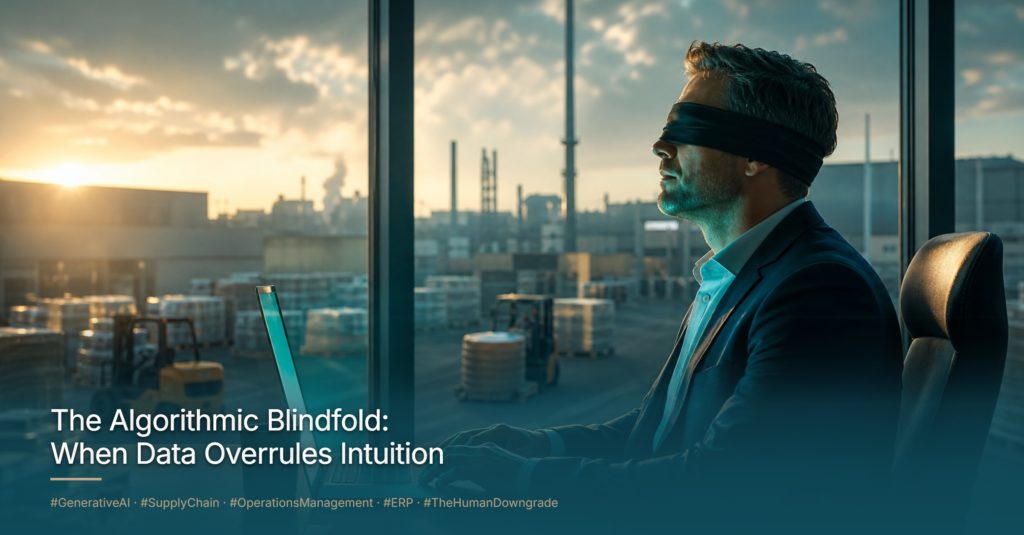
This disconnect is a growing threat in modern enterprise management. We’re installing advanced systems to monitor our operations, but we’re also installing a digital blindfold. When we look at a screen that tells us everything is operating without errors, we lose the drive to verify if the physical world matches the database.
In the case of my friend’s plant, the consultants had built a beautiful, mathematically sound model. On paper, it was perfect. But it was detached from the actual state of the production line.
This is a psychological phenomenon known as automation complacency. When a system works as expected, human operators stop auditing its output. They become passive monitors rather than active decision-makers. They assume the algorithm knows something they don’t, and they ignore the warning signs right in front of them.
Sounds familiar? It should. It’s the same thing we do with GPS navigation: follow the route blindly until we end up in a dead-end street.
In a supply chain, this complacency is dangerous. A dashboard can tell you that inventory levels are healthy. It cannot show you the damaged boxes, the warehouse layout causing bottlenecks, or the operators too exhausted to keep up. The screen shows the plan, but the loading bay shows the execution.
My point is: if you manage your business through metrics alone, you are managing a simulation. The real business is happening where the concrete meets the tires, and that is where your attention must be.
The Death of Operational Intuition
Since I’ve memory, the best managers relied on what they used to call gut feeling. This wasn’t some mystical power. It was the result of years spent walking the shop floor, observing processes, and talking to operators. It was rapid, subconscious pattern recognition.
An experienced logistics manager can walk into a warehouse and know within seconds if something is wrong. They notice pallets left in the wrong aisles, blocking transit routes, or containers with labels that don’t match the physical materials inside. They don’t need a KPI report to tell them that the receiving process is backing up; they see it in the physical clutter on the dock.
This operational intuition is a critical line of defense against system failures.
But as we delegate more decisions to algorithms, we’re letting this muscle atrophy. When a manager relies on automated forecasts and prescriptive suggestions, they stop walking the floor.
They stop observing the physical cues. They spend their days in steering committee meetings, looking at slides, and adjusting parameters in their ERP systems.
In doing so, they trade their deep, firsthand understanding of the operations for a simplified model. They become dependent on the software to tell them what is happening, losing the ability to read the room, the dock, or the assembly line.
When Data Overrules Intuition
What happens when the dashboard and the physical reality disagree?
In a healthy organization, the physical reality wins. If the forecasting system says demand for a product is soaring, but the sales team reports that clients are canceling orders, you trust the sales team. If the WMS says a bin is empty, but a forklift driver is looking at a physical pallet of steel, the pallet is real.
But in an algorithm-first company, the opposite happens. The data is treated as the ultimate truth, and the human observation is treated as an anomaly or a mistake.
I have seen this play out in major system integrations. A WMS and an ERP fall out of sync because a few lines in an integration message fail to process. The system dashboard reports that the shipping schedule is on track, while the physical trucks are leaving the loading bay half-empty. Instead of listening to the shipping clerk who warns that orders are being missed, managers spend hours auditing the database, convinced that the system can’t lie and that the human must be mistaken.
The same blind trust ruins production planning. An MRP system plans manufacturing runs based on theoretical inventory levels. If the database contains ghost inventory (materials that were lost, scrapped without a transaction, or put in the wrong bin), the MRP will schedule jobs that cannot be executed.
Yet, rather than walking onto the warehouse floor to count the physical stock, teams continue to trust the system, blaming the operators for the resulting delays.
This is the algorithmic blindfold. It makes us believe that if it can’t be measured and displayed on a chart, it doesn’t exist. It teaches us to disregard our senses, our experience, and the feedback of our people in favor of a mathematical abstraction.
In the end, data is a representation of reality. A historical record, subject to delays, errors, and simplification. It can never capture the full complexity of a physical operation.
Reclaiming Your Operational Sight
To prevent this downgrade, leaders and consultants must fight the temptation to manage everything from behind a screen. We need to build systems that support human judgment.
Here are three principles to restore balance:
1. Go to the Source.
Don’t rely on a daily report to understand why a project is delayed or why the warehouse is backing up. Walk the production line. Stand at the loading bay. Speak to the operators who run the process on the floor. Five minutes of physical observation will teach you more than a fifty-slide PowerPoint presentation ever could.
2. Audit the Algorithms.
Treat every AI suggestion, forecast, and dashboard as a hypothesis to verify. Encourage your team to challenge the system. If a predictive model recommends a major change in production planning, ask for the underlying assumptions. If those assumptions contradict what you see in the physical world, trust your eyes.
3. Cultivate Human Expertise.
Don’t let your team outsource their thinking to software. Use ERP systems and AI tools to handle routine data entry and analysis, but keep the decision-making power in human hands. Train your consultants to understand the physical flows first and the software configurations second. An expert who only knows how to press buttons is just an operator.
Where the Dashboard Ends
Enterprise software should be a tool that enhances our vision, not a blindfold that replaces it.
If the dashboard says everything is fine but the warehouse is in chaos, you must believe the warehouse. The physical world doesn’t lie. Data, however, can be manipulated, misconfigured, or incorrect.
The next time you are faced with a critical decision, close the browser tab. Walk away from the C-suite planning session. Walk down to the shop floor, look at the physical reality, and talk to your team.
Trust me: your gut feeling isn’t a relic of the past. It is the sum of your hard-earned experience.
Don’t let the algorithm overrule it.
Written by Andrea Guaccio
September 03, 2026