

The Best AI Implementer Is Not a Developer
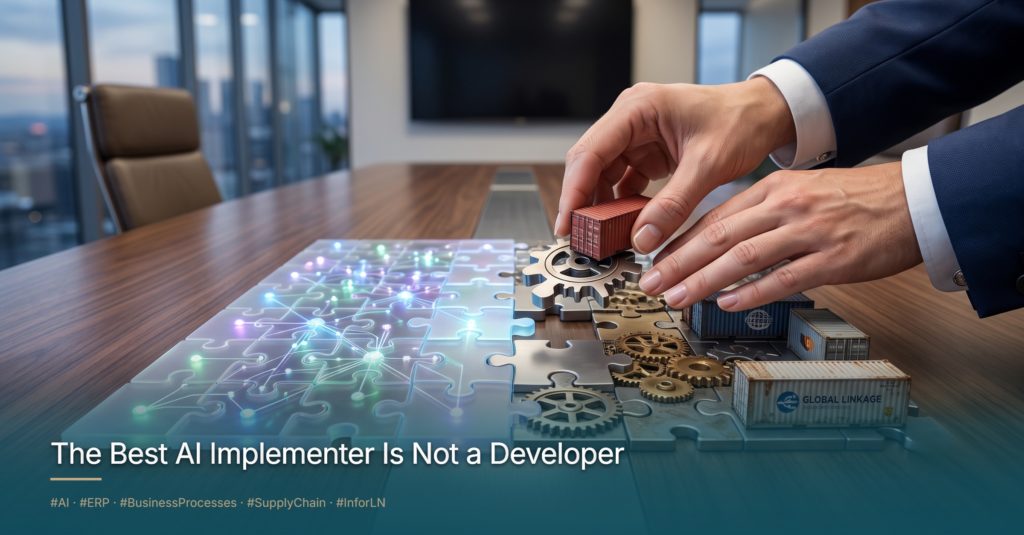
The market is currently flooded with certified AI experts who know everything about language models and absolutely nothing about your supply chain. The hard truth is that the best person to implement AI in your company isn’t a developer. It’s your current consultant.
The AI Expert Bubble
Over the past year, a new industry has emerged overnight. Thousands of professionals have rebranded themselves as artificial intelligence specialists. They hold certifications, they understand neural network architectures, and they know how to configure autonomous agents ( Autonomous-ish I’d say).
The corporate world has bought into this narrative. Companies assume that because artificial intelligence is a highly complex technical subject, the implementation must be led by a programmer.
This assumption in my opinion is totally misleading and is delaying real innovation.
We’re treating AI like it’s just another software deployment. We assume that if we write the code correctly and connect the APIs, the business value will naturally follow.
But enterprise systems don’t operate in a vacuum. They operate in the messy reality of the business world. Knowing how to write Python is useless if you don’t understand how materials actually move across the warehouse floor.
We see professionals waving certifications from online courses, claiming they can revolutionize your business. They talk about vector databases, retrieval-augmented generation, and fine-tuning. They speak a language that dazzles management. Actually, It would dazzle everyone.
But when you place some of them in a real manufacturing environment, the illusion shatters. They don’t know the difference between a work center and a machine center and for sure they can’t explain how a bill of materials impacts procurement.
Theoretical knowledge of an algorithm is disconnected from the reality of applying that algorithm to a physical supply chain. You can’t optimize an inventory flow if you don’t understand what inventory actually represents to the company’s cash flow.
The Danger of the Unquestioning Developer
When one of these AI experts / developer takes control of an implementation, they focus entirely on the technology. They will look at the client’s request as a set of technical requirements to be fulfilled.
If the client asks for an intelligent agent to automate a specific task, the developer will build it. They’ll optimize the code, reduce the latency, and ensure the system runs flawlessly.
They’ll rarely stop to question the underlying business logic. They won’t ask if that specific task should even exist in the first place.
Clients often state one requirement when they actually need something different. They propose complex technical solutions to mask deep operational failures.
A developer without functional experience won’t recognize this discrepancy. They’ll deliver exactly what the client asked for, without ever addressing the real pain point. They’ll spend months building a highly advanced tool that optimizes a broken process.
The 20-Year Data Debt
This problem is amplified by a severe lack of technological culture in executive offices. Many leaders view artificial intelligence as a magical entity capable of independent thought.
They believe this new technology will autonomously crawl through their servers, understand their business logic, and somehow clean up twenty years of human mistakes.
They want to deploy generative AI before they’ve even analyzed their own operational flows. They want advanced predictive analytics, but their master data is a sprawling mess of contradictions, duplicate entries, and missing values.
There’s a stubborn belief that an algorithm can fix a disjointed supply chain. It can’t.
If you don’t know where your critical data lives, an LLM won’t find it for you. If your processes are undocumented and chaotic, AI will only throw that chaos back to you.
Long story short: applying intelligent automation on top of a broken foundation is a guaranteed path to operational disaster. I’ve made this argument before. I expect to keep making it.
The Importance of Industry Standards
Consider a scenario where a company decides to rewrite how their Material Requirements Planning (MRP) operates. They want to abandon the standard logic and use machine learning to create a customized algorithm.
A pure developer might view this as a mathematical challenge. They’ll start designing the new system, ignoring decades of established best practices.
An experienced functional consultant will immediately stop the request.
There’s a reason why certain operational flows have become industry standards. You don’t reinvent a Kanban system or an MRP core logic simply because you want to play with modern technology.
If you rip out a working MRP just to say you’re using machine learning, you are not innovating at all.
The customer often believes that their specific business is entirely unique. They believe their inefficiencies require a bespoke, ground-up technological solution.
Whether you accept it or not, it’s the job of the consultant to challenge this belief. A seasoned professional knows that eighty percent of corporate problems are universally shared. The solution is rarely a custom-built AI model. The solution is usually enforcing discipline and aligning with standard workflows as much as possible.
A developer will build the bespoke model, validating the customer’s flawed belief. The functional consultant will refuse to build it, saving the customer from years of technical debt.
By now we should all know that client doesn’t care about your software stack. They care about their margins. Sometimes, the most valuable advice you can give as a consultant is simply telling them to leave a working system alone.
Context is the Real Currency
This brings us to the core reality of modern implementation. A functional consultant who already works with ERP, CRM, or Business Intelligence systems has a monumental advantage over a pure AI developer / consultant.
The functional consultant already knows the corporate processes. They’ve spent years mapping workflows, tracking inventory, and resolving bottlenecks.
They understand that corporate data is rarely clean. They know that the actual workflow on the shop floor almost never matches the official documentation.
When an ERP consultant approaches an AI project, they start by hunting down the exact operational bottleneck. They already know where the corporate inefficiencies are hiding. The AI is just the hammer they use to smash them.
The Missing Synergy
I want to stress this: the developer isn’t going anywhere. We absolutely need technical specialists. They are the only ones who understand the hard limits of the software, the hardware infrastructure, and the deployment environments where these systems actually run.
We don’t have a developer problem. We have a problem with amateur Python scripters jumping on the AI bandwagon and pretending they can run a business implementation alone.
A functional consultant will always need to work in strict synergy with a technical counterpart.
The real magic happens when these two profiles collide. On one side, you have the functional expert: deeply rooted in human confrontation, process analysis, and supply chain logic. On the other side, you have the developer: obsessed with code efficiency, latency, and architecture.
And trust me, to make these solutions actually work, we need obsession.
Put the person who knows exactly what to fix in the same room with the person who knows exactly how to build it. That’s how you stop playing with toys and actually deliver a successful implementation.
Written by Andrea Guaccio
July 28, 2026