

From Iron to Cloud: The Blueprint for MES Integration
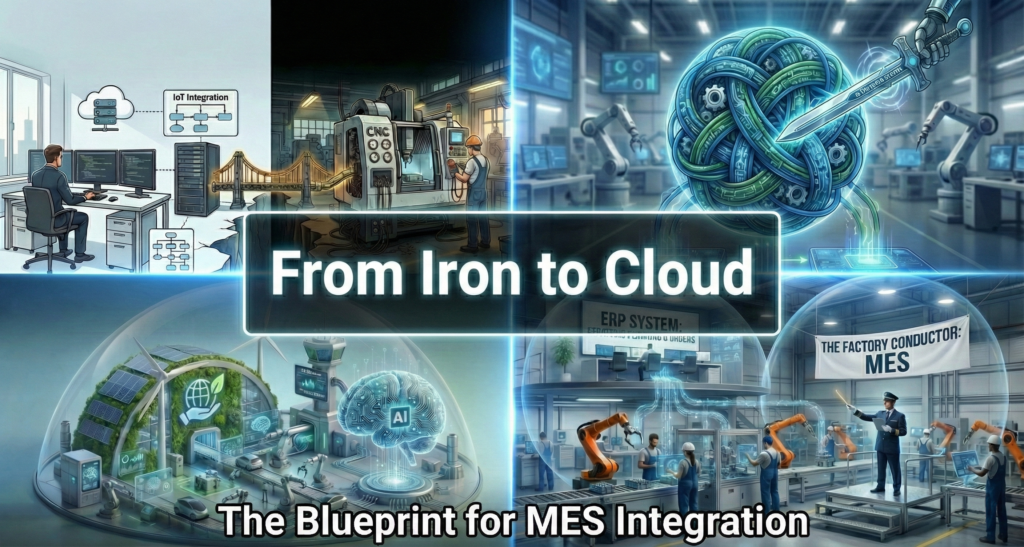
There are two truths in every manufacturing company.
The first truth lives in the boardroom. It is written in the pristine rows of Infor LN, defined by Standard Costs, Master Production Schedules (MPS), and financial forecasts. It is a world of logic, planning, and clean data. It is the map of the territory.
The second truth lives on the shop floor. It is written in the noise of CNC machines, the smell of coolant, and the sudden failure of a hydraulic pump at 2:00 AM. It is a world of physics, friction, and entropy. It is the territory itself.
For far too long, a dangerous Digital Chasm has separated these two worlds.
We spend millions implementing ERP systems to plan our resources down to the decimal point. Yet, the moment a Production Order is released, it disappears into a Black Hole. It re-emerges days later, often inaccurate, when a shift supervisor manually types (or mistypes) the production quantities into a terminal.
This lag creates a Hidden Factory: a phantom operation where efficiency losses, energy waste, and quality drifts happen invisibly, completely undetected by the ERP until the month-end close.
In 2026, this gap represents an existential risk.
Why This Series Exists
I have spent over a decade working as an ERP Consultant Specialist.
While my background spans across various platforms, I have dedicated the vast majority of my career to mastering Infor LN Cloudsuite.
I have spent most of this time walking the floors of Industrial Machinery workshops and companies serving the Automotive sector, and I have seen the same pattern repeat itself.
Companies try to force their ERP to manage the micro-seconds of the shop floor (and fail). Or, they buy an expensive MES that acts as a standalone island, creating a Data Hell of unsynchronized Master Data.
The industry is full of high-level buzzwords about Industry 4.0, but it is starving for practical, architectural guidance.
That is where From Iron to Cloud comes in.
I structured this series to serve as a comprehensive technical and operational blueprint. It speaks directly to the CIO seeking budget justification, the Solution Architect mapping XML BODs, and the Plant Manager troubleshooting connectivity issues.
We will leave the theory behind and walk the entire path: from the raw voltage of a PLC, through the Edge Gateway, up to the MES, and finally into the financial heart of Infor LN.
Here is the roadmap of our journey over the next few weeks.
Part 1: The Factory Conductor
We begin by establishing the rules of engagement.
The most common mistake in digital transformation is role confusion. We often ask, Can’t Infor LN just track production?
In Part 1, we answer that question with a definitive “No, and here is why.” We explore the ISA-95 standard to define the clear boundary between Level 4 (Business Strategy) and Level 3 (Operations Execution).
We will debunk the Excel Myth, the widespread dangerous reliance on spreadsheets to manage complex scheduling and introduce the concept of the MES not as a competitor to the ERP, but as its Lieutenant.
The ERP plans the war; the MES fights the battle. We will discuss the Core Four functionalities (Dispatching, Traceability, OEE, Maintenance) that justify the investment to your CFO.
Read the full article here.
Part 2: The Gordian Knot
Once we agree we need both systems, we face the hardest technical challenge: Integration. This is where 80% of projects go over budget.
In Part 2, we cut the Gordian Knot. We dive deep into the architecture of Infor ION and the OAGIS standard. We tackle the uncomfortable questions:
- Who owns the Item Master?
- What happens if I change a Bill of Materials (BOM) in Infor LN while the order is already running on the MES?
- How do we prevent the Split Brain scenario where Finance sees one cost and Operations sees another?
I will introduce the Read-Only Doctrine, a strict governance protocol I have developed to ensure data integrity during Engineering Change Orders (ECOs).
Read the full article here.
Part 3: Machines Don’t Speak HTTP. They Speak Voltage and Registers.
For a software architect, the physical world is often an abstraction. In Part 3, we put on our safety boots and go down to the machine level.
We confront the IT/OT Gap. Your 1990s stamping press does not have a REST API. It does not speak JSON. It speaks in voltage drops and Modbus registers.
We will explore the Protocol Zoo (Siemens S7, Modbus TCP, OPC-UA) and explain the critical role of the Edge Gateway (the Translator). We will discuss why streaming terabytes of raw vibration data directly into the Cloud is a recipe for disaster (Data Gluttony) and how to implement an Edge Computing strategy that filters the noise on the floor and sends only the valuable signals to the boardroom.
Part 4: The Cognitive Factory
Finally, in Part 4, we look at the horizon. We move beyond connectivity into intelligence.
The factory of 2025 is not just automated; it is Cognitive. We will explore how Generative AI and “Agentic Workflows” are changing the user interface from static dashboards to conversational assistants (“Show me why Line B stopped”).
We will tackle Sustainability (ESG) not as a compliance task, but as a core manufacturing parameter. I will demonstrate the Dynamic Injection pattern: treating Energy as a Bill of Materials component to calculate the true, granular cost of every single Production Order in Infor LN.
Insights from Direct Experience
The insights provided in this series stem directly from fieldwork.
They represent a synthesis of methodologies verified in go-lives and practical solutions to the complex challenges that arise in real-world manufacturing environments.
Whether you are an IT Director, a Supply Chain Manager, or an ERP specialist, these articles provide the vocabulary and the architecture required to lead your organization From Iron to Cloud.
Written by Andrea Guaccio
January 21 2026