

Validation et hypersoins
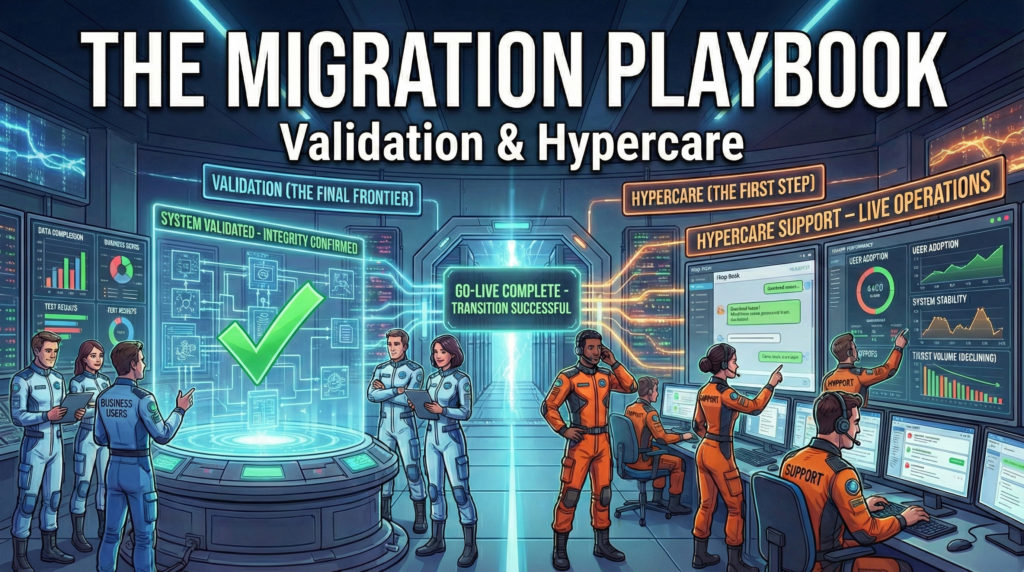
(Sixième et dernière partie de la série en six parties « Le guide de la migration »)
Dans la partie 5, nous avons maîtrisé le langage des journaux et effectué les simulations. La semaine dernière, le plan de basculement a été exécuté à la perfection. Le point de non-retour est désormais derrière vous.
Nous sommes lundi matin, 8h00. Les utilisateurs se connectent Infor LN CloudSuite en environnement réel.
Lundi matin ne marque pas la fin du projet. C'est là que les choses sérieuses commencent. C'est le début de la phase la plus critique et la plus instable de toute la mise en œuvre : l'hyperassistance.
La salle de crise : survivre aux 72 premières heures
Lors de la mise en service du système, le chaos est inévitable. Les utilisateurs seront désorientés. L'interface sera différente. Des opérations qui nécessitaient deux clics dans l'ancien système en requièrent désormais trois.
Vous pouvez passer des centaines d'heures en formations, rédiger des manuels impeccables et enregistrer d'innombrables tutoriels vidéo. La panique finira par s'installer. Un pourcentage important d'utilisateurs resteront plantés devant les nouveaux écrans, comme s'ils se connectaient à un ERP pour la toute première fois.
(Attention, divulgation : pour beaucoup d’entre eux, ce sera en fait leur première connexion. Que cela vous plaise ou non.)
Vous ne pouvez pas gérer ce chaos par le biais d'un système de tickets par e-mail classique. Il vous faut une cellule de crise.
Qu’elle soit physique (une salle de conférence dédiée dans l’atelier) ou virtuelle (une passerelle Teams toujours ouverte), la salle de crise est le centre de commandement centralisé pour la mise en production. Elle est composée des consultants principaux, du chef de projet interne et des utilisateurs clés.
Triage : Bugs système vs. Courbe d'apprentissage
Pendant les 72 premières heures, le téléphone sonne sans arrêt : « Le système est en panne ! Je ne peux pas expédier la commande ! »
La compétence la plus importante dans la salle de crise est le triage. Vous devez instantanément classer chaque crise entrante dans l'une des deux catégories.
1. Courbe d'apprentissage (erreur de l'utilisateur)
- L'utilisateur a oublié de vérifier le bon de livraison avant de confirmer l'expédition, ou il utilise la mauvaise session d'entreposage.
- Un accompagnement immédiat et direct. Il s'agit d'un problème fréquent d'adaptation humaine. L'utilisateur clé intervient, guide l'opérateur et transforme la situation de panique en une occasion de formation.
Si l'utilisateur clé ne peut pas apporter son soutien, le consultant doit intervenir avec tact. La règle d'or dans la salle de crise est le calme : tout doit paraître parfaitement prévisible. Même face à des problèmes réels, afficher une maîtrise sereine rassure l'utilisateur et lui fait comprendre que les imprévus font partie intégrante du processus de mise en production.
2. Bug système (Code rouge)
- L'utilisateur fait tout correctement, mais un script en arrière-plan plante, une intégration personnalisée ne parvient pas à envoyer la facture au portail externe ou une validation DAL bloque une transaction légitime.
- Escalade technique immédiate. Faites intervenir le développeur. Analysez l'architecture et déboguez l'API ou l'extension. Votre rôle de consultant est d'accompagner le développeur dans tous les tests nécessaires à la reproduction de l'erreur, notamment en exécutant des scénarios dans l'environnement TRN.
Conseil du consultant : La première semaine, 80 % des bugs critiques signalés sont en réalité dus à des oublis de formation de la part des utilisateurs. Filtrez le bruit. Rassurez les utilisateurs. Protégez vos développeurs afin qu’ils puissent se concentrer sur les 20 % de bugs réellement critiques.
La règle d'or des environnements : TRN = PRD
Pendant la phase d'hyperassistance, vos environnements TRN (entraînement/simulation) et PRD (production) doivent rester parfaitement identiques, notamment en ce qui concerne les personnalisations.
Il arrive trop souvent, lors des phases de mise en production, que des correctifs urgents soient déployés directement en environnement de production pour gagner du temps, sans que l'on oublie de les aligner sur l'environnement de test. C'est une erreur fatale. Elle vous coûtera cher lorsque vous devrez tester le prochain correctif critique dans un environnement qui ne correspond plus à la réalité.
Maintenez la discipline de votre gestion des mises en production, même sous pression.
Gouvernance des soins hyper-intensifs : Le rythme quotidien
L'hyper-assistance, officiellement appelée phase de transition en gestion de projet , dure généralement entre 2 et 4 semaines. Pour prévenir l'épuisement professionnel et garder un contrôle absolu sur le chaos ambiant, deux éléments sont indispensables : un outil de suivi centralisé et un rythme quotidien strict.
Suivi des problèmes
Il est impossible de gérer les problèmes de mise en production par des échanges d'emails, des messages de chat épars ou des conversations informelles. Vous avez besoin d'un outil de suivi dédié (Jira, un tableur Excel ou tout autre système de gestion des tickets) pour consigner chaque problème rencontré. Chaque entrée doit être catégorisée selon :
- Type : Lacune fonctionnelle, erreur de l'utilisateur ou bogue logiciel ?
- Propriété : Qui en assure actuellement la gestion ?
- Statut : Ouvert, En cours, Bloqué ou Résolu.
Le rythme quotidien
- Réunion matinale : un briefing de 15 minutes à l'aide de l'outil de suivi des problèmes. Quels ont été les problèmes rencontrés hier ? Quelles sont les corrections prioritaires pour aujourd'hui ?
- Tout au long de la journée : l’équipe effectue des tournées sur le terrain, fournissant un soutien continu et résolvant immédiatement les problèmes de niveau 1 (courbe d’apprentissage).
- 17h00 – Réunion de triage : Examiner tous les tickets non résolus. Les attribuer aux ressources techniques ou les transmettre au support Infor s’il s’agit d’un problème lié au produit principal.
Rapprochement financier : la bénédiction du directeur financier
Bien que la cellule de crise gère les incidents opérationnels, le juge ultime de votre stratégie de transition reste le directeur financier.
En tant que consultants en chaîne d'approvisionnement ou en production, nous n'entretenons peut-être pas les détails les plus fins des comptes. Mais il faut bien reconnaître ceci : si les chiffres financiers ne correspondent pas, la migration est un échec.
Vous devez être en mesure de prouver que la valeur de l'inventaire historique est égale à la valeur de l'inventaire Infor LN et que les balances d'ouverture (comptes clients, comptes fournisseurs, grand livre) reflètent les soldes de clôture historiques.
En réalité, ce rapprochement définitif a rarement lieu le lundi matin. Il se déroule discrètement en arrière-plan durant les premiers jours, pour généralement prendre toute son importance lors de la fameuse première clôture mensuelle. Lorsque la première vague massive de facturation et de clôture des comptes arrive, la moindre anomalie (même les différences d'arrondi ou les dates de conversion de devises) apparaît et doit être justifiée par l' Finance . Réussir cette première clôture mensuelle et produire un rapprochement financier sans erreur est la preuve officielle et finale que la migration a été un succès.
Du chaos hérité à l'ère de l'IA
À la fin des semaines d'Hypercare, le nombre de tickets diminue. Les utilisateurs cessent de se plaindre de la nouvelle interface et commencent à se rendre compte qu'ils peuvent retracer de nombreux aspects, du fournisseur à la machine finie, en trois minutes.
Le système se stabilise. Il est temps d'examiner ce que vous avez réellement construit.
En adoptant la stratégie de migration radicale , en appliquant une gouvernance des données rigoureuse , en respectant la doctrine DAL et en exécutant la migration avec minutie , vous avez bâti un système propre . Vous avez définitivement éliminé des années de données erronées et de processus obsolètes.
Avec vos données désormais structurées, enrichies et archivées dans votre ERP, votre usine est officiellement prête pour l'IA.
- Au lieu d'analyser manuellement les stocks de sécurité, des algorithmes prédictifs peuvent désormais examiner vos données de consommation et suggérer automatiquement des ajustements d'inventaire.
- Au lieu de parcourir dix menus, votre responsable d'usine peut saisir dans une interface de chat : « Affichez-moi les principales causes de rebuts sur la ligne 2 cette semaine. » Grâce à la qualité des données sous-jacentes, les réponses de l'IA seront plus précises.
Vous avez fait passer votre entreprise d'une analyse rétrospective descriptive à une analyse prospective prédictive.
Explorez l'écosystème que vous venez de débloquer :
- Décryptage du paysage de l'IA
- Dialoguer avec vos données : par exemple, en utilisant la BI générative
- Données exploitables en périphérie : utilisez vos requêtes les plus nécessaires directement dans les widgets.
Conclusion du manuel de jeu
Une migration réussie ne se résume jamais à déplacer des données d'un point A à un point B. Elle exige assurément une maîtrise technique et une gestion de projet rigoureuse.
Mais surtout, cela exige une compréhension profonde de la psychologie humaine, une qualité de plus en plus absente des exigences modernes en matière de CV.
Lors du stress et de la nervosité extrêmes d'une mise en production, l'empathie est le véritable facteur de différenciation. Il s'agit de savoir parler le bon langage et de servir de médiateur entre toutes les parties prenantes : l'opérateur d'entrepôt paniqué, le développeur interne épuisé et le directeur financier anxieux.
Un véritable consultant est un allié sur le terrain, et non une IA qui exécute aveuglément des tâches sans jamais remettre en question une mauvaise idée. Nous guidons, nous remettons en question et nous amortissons les chocs. Cette dimension humaine est, et restera, la compétence la plus essentielle dans notre secteur aujourd'hui.
Nous avons débuté dans le chaos des systèmes hérités, submergés par des données erronées et des solutions de contournement manuelles. Grâce à la discipline et à la méthodologie, nous sommes parvenus à une entreprise moderne, unifiée et cognitive.
Et maintenant ? Nous allons perfectionner ce qui est nécessaire. Nous implémentons enfin tous ces modules avancés, automatisations et fonctionnalités que nous avons dû impitoyablement reporter lors de la phase de conception, faute de temps ou parce que l'organisation n'était pas encore suffisamment mature pour les intégrer. Les bases sont solides. Il est temps de construire.
Écrit par Andrea Guaccio
16 avril 2026