

The ERP Intelligence Evolution: From Static Data to Autonomous Agents
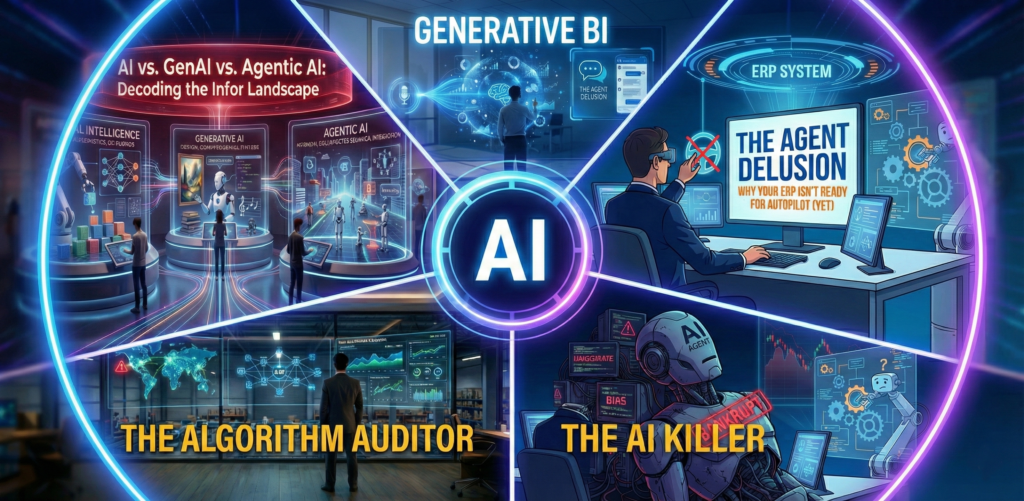
(Introduction to the 5-Part Series)
We are standing on the edge of the single biggest shift in ERP history since the migration from green screens (character-based interfaces) to Windows graphical interfaces in the 1990s.
That shift changed how we look at the system. This shift changes who does the work.
But right now, the market is drowning in noise. If you ask five different experts what AI in ERP means, you get five different answers.
“Is it ChatGPT plugged into my warehouse?” “Is it a chatbot that answers support tickets?” “Is it a robot that automatically buys materials when stock is low?”
The confusion is high, and most of all, the hype is dangerous. CIOs and Supply Chain Directors are under immense pressure to Adopt AI, but they often lack a clear engineering roadmap to get there.
They are being sold the dream of a Self-Driving Enterprise while sitting on a database full of duplicates and disconnected legacy processes.
The Reality Check
In the Infor LN CloudSuite ecosystem, the roadmap is actually very clear, but it requires a strict evolution of technology, data, and, most importantly, mindset.
You cannot jump straight to Autonomous Agents if your master data is dirty. You cannot trust an AI to execute financial transactions if you don’t understand the fundamental difference between a Generative model (that writes emails) and a Predictive model (that forecasts demand).
We need to stop treating AI as a magic wand and start treating it as an engineering discipline.
The Series Roadmap
Over the next 5 episodes, I will be publishing a deep-dive series titled: The ERP Intelligence Evolution.
We will strip away the marketing buzzwords and look at the engineering reality of the Intelligent Enterprise. We will dissect the Infor architecture, expose the risks, and define the new human roles required to survive.
Here is the roadmap we will travel together:
Part 1: AI vs. GenAI vs. Agentic AI – Decoding the Infor Landscape
Before we build, we must define. One of the biggest reasons AI projects fail is a misunderstanding of the toolset. Infor’s architecture is a trinity of distinct technologies. In this first episode, we will decode the specific differences between:
- Infor AI (Machine Learning): the Math Geek that predicts the future based on history.
- GenAI (LLMs): the Creative Assistant that understands language and context.
- Agentic AI: the Autonomous Worker that can execute multi-step tasks. We will analyze why mixing them up is a recipe for failure and how to map them to your business problems.
Read the full article here.
Part 2: Generative BI – Talking to Your Data
The era of the static dashboard is ending. For long time, business users have been dependent on IT analysts to build reports. If a CEO asked, “Why is margin down in Italy?”, the answer took three days of SQL queries.
In Part 2, we explore the democratization of data via Text-to-SQL technology. We will see how Generative BI allows users to simply ask the ERP complex questions in natural language and get instant, visual answers. This bridges the gap between technical complexity and business insight.
Read the full article here
Part 3: The Agent Delusion – Why Your ERP Isn’t Ready for Autopilot
The industry promises Self-Driving Enterprises. I call it The Agent Delusion. While the technology for Agentic AI exists, the governance does not. We will analyze why handing over the keys to an Outcome-Driven Agent (one that figures out its own path to a goal) without Orchestrated Control is a massive financial risk. We will discuss why the Human-in-the-Loop is not a bug or a limitation, but the most critical safety feature of the next decade.
Read the full article here.
Part 4: The AI Killer – Why Dirty Data Will Bankrupt Your Agent
Garbage In, Garbage Out used to be an annoyance. A human planner could see a blank lead time and guess the correct value. With Agents, Garbage In becomes Disaster Out. An Agent sees a blank lead time and orders air freight, destroying your margin in milliseconds.
In Part 4, we will discuss why Master Data Governance is no longer a boring IT ticket, but the single most critical prerequisite for AI adoption. We will prove that without clean data, your Smart Warehouse is just an automated chaos generator.
Read the full article here.
Part 5: The Algorithm Auditor – The New Role of the ERP Expert
Finally, we face the most personal question: What happens to us? If the Agent monitors the stock, and GenBI answers the questions, what is left for the consultant and the super-user? The answer is: Everything, but different.
As the AI takes over the low-value execution tasks (The Doer), the human must evolve into a new, higher-value role: The Algorithm Auditor. We will explore the three new skills (Causality Analysis, Exception Management, Governance) that you need to master to stay relevant over the years to come.
Read the full article here.
Why This Series Matters Now
We are not talking about science fiction or R&D prototypes. The technology described in this series (Infor AI, GenAI integration) is available now or is in the immediate roadmap for 2026.
The companies that understand this evolution will gain a massive competitive advantage in speed and agility. Those who ignore it, or worse, those who rush into it without understanding the foundations, will spend the next years cleaning up the mess.
Written by Andrea Guaccio
December 10, 2025